
Compact 100x100mm Preheat Station
4.8Editor score
Compact 100x100mm platform
Adjustable 30–400°C range
Real-time sensor feedback
Discover the best soldering hot plate options, comparing heating size, power, temperature control, cooling, voltage, and electronics rework features.
A soldering hot plate provides a broad, controlled heating surface for tasks that exceed the reach or consistency of a handheld iron. The right model can help with PCB rework, SMD component removal, phone screen separation, BGA work, adhesive removal, and other electronics or laboratory applications. Important considerations include heating area, wattage, temperature range, control accuracy, voltage compatibility, cooling design, and how securely a workpiece can be positioned.
This guide compares ten soldering hot plates using the supplied specifications, customer ratings, heating dimensions, power ratings, control systems, and stated applications. The list includes compact aluminum platforms, large 200 by 200mm heating surfaces, digital microcomputer models, an infrared preheating oven, and a general laboratory hot plate that is explicitly unsuitable for PCB reflow. It covers both dedicated electronics-rework tools and versatile heating platforms for technical work.
Each review highlights the product's most useful characteristics, practical trade-offs, and likely audience. The featured top picks include the 100 by 100mm model for compact multi-point heating, the 200 by 200mm version for larger jobs, and the WEP platform for focused SMD and BGA work. Ratings and specifications reflect the supplied listings, while prices and availability can change, so compare the current listing before purchasing.
4.8Editor score

4.8Editor score

4.6Editor score
The comparison below highlights the major differences in heating surface, power, control method, and intended use. It makes clear which models suit compact electronics work, which accommodate larger boards, and which are purpose-built for BGA or SMD rework.



The 850W Soldering Hot Plate 200x200mm LED Electric Preheat Rework Station is a broad-area heating platform rated 4.4 by customers. Its most immediately attractive feature is the 200 by 200mm aluminum surface, which provides enough room to position components, small boards, phone screens, or several workpieces at once. The listed 850W output and 30–400°C control range make it suitable for demanding soldering, SMD rework, and preheating jobs.
We may earn a commission when you buy through this link, at no additional cost to you.
The aluminum plate uses multi-tube heating technology to transfer heat efficiently across the work area. A CPU-based constant-temperature controller is designed to regulate the platform and support consistent heating. Multi-angle cooling holes improve ventilation around the unit, while the stated applications extend well beyond conventional soldering to LED display work, aluminum substrate maintenance, mold-core preheating, sealing, dispensing, sample heating, laboratory analysis, and teaching research.
The main trade-off is that this listing emphasizes accurate temperature control but does not mention a front-panel calibration function or a work-positioning fixture. That means it may be less convenient for users who routinely need independent calibration or a mechanical way to secure irregular parts. Its broad plate also requires more bench space than compact electronics-rework platforms, and the supplied information does not identify its operating voltage as clearly as some competing listings.
This is a strong choice for repair technicians, LED-industry users, and technical hobbyists who want a large, versatile heating surface. It is less obviously ideal for very small BGA packages requiring a focused footprint. For users who regularly heat multiple small components or larger boards, however, the combination of surface area, power, temperature range, and broad application support makes this an effective general-purpose soldering hot plate.
The 200 by 200mm platform lets users heat multiple joints or components without heating them one at a time. That larger working area can reduce repeated handling and make it easier to rework sections of a board.
Three-dimensional cooling holes are intended to dissipate heat efficiently from multiple directions. This is particularly useful during sustained electronics work where heat buildup around the platform could otherwise affect stability.
We may earn a commission when you buy through this link, at no additional cost to you.
The 350W Soldering Hot Plate with a 100 by 100mm surface is a compact choice for focused electronics work. Its supplied rating of 4.6 is among the stronger customer feedback figures in this list. The platform combines a relatively compact aluminum plate with a broad 30–400°C adjustment range, making it useful for phone screen repair, LED display work, component processing, SMD reengineering, PCB removal, and soldering.
We may earn a commission when you buy through this link, at no additional cost to you.
Multi-tube heating technology is used beneath the aluminum plate to promote efficient heat transfer. The high-performance CPU controller provides the stated temperature regulation, and a two-dimensional, multi-angle cooling-hole design helps vent heat from the unit. This combination makes the product practical for users who want a dedicated preheat platform without taking up the space required by a 200 by 200mm model.
Its main limitation is capacity. A 100 by 100mm area can handle small PCBs, phone components, and other compact assemblies, but it offers less freedom for oversized screens, elongated boards, or several unrelated workpieces. The listed cooling design is also less extensive than the three-dimensional arrangements offered by some larger alternatives. Users needing a work-positioning system may prefer one of the models with adjustable holding hardware.
This hot plate is best suited to electronics repair benches where a compact, controlled preheating area is more valuable than maximum surface area. It also works for lab, teaching, and general heating tasks within the stated temperature range. Buyers should confirm that its physical dimensions and power requirements fit their workspace before ordering, but for small-component work it offers a focused and potentially less crowded alternative to a full-size platform.
The adjustable 30–400°C range covers mild warming through to higher-temperature soldering and rework. Digital temperature regulation is particularly helpful when work changes between delicate components and more demanding heating tasks.
The compact plate leaves more room for tools and components on a crowded bench. It is a practical match for users who mostly handle small circuit boards rather than large phone screens or multi-board assemblies.
We may earn a commission when you buy through this link, at no additional cost to you.
The Compact Digital PCB Preheater earns a 4.8 customer rating and stands out for combining digital feedback, multi-point heating, and a practical 100 by 100mm aluminum alloy surface. Its microcomputer control system monitors temperature with a sensor and adjusts heating power to help maintain a stable target. The stated 30–400°C range gives users useful flexibility for soldering, PCB rework, SMD removal, and component processing.
We may earn a commission when you buy through this link, at no additional cost to you.
The main benefit is the ability to heat several solder joints or nearby components simultaneously. That approach can reduce repeated heating cycles and is especially relevant to motherboard repair, where working on one joint at a time can prolong the job. A digital display provides a clear reference for the current setting, while two-sided ventilation and a multi-angle cooling structure help dissipate heat during longer sessions.
The trade-offs are mostly practical rather than functional. This model is explicitly rated for 110V, so it is not the appropriate choice for a 220V circuit without a suitable conversion solution. Its compact size limits large workpieces, and the listing does not mention an adjustable holder. Those omissions matter less for users who can safely position a small board on the surface, but more for technicians handling irregular or heavy assemblies.
This is our Best Budget pick because it combines a high rating with focused electronics features at a comparatively accessible tier. It suits mobile phone motherboard technicians, electronics hobbyists, engineers, and researchers who need a dependable 100mm platform with digital temperature control. Verify the electrical specification before use, and choose a larger model if the work regularly involves phone screens, long boards, or multiple simultaneous assemblies.
Real-time sensor feedback allows the microcomputer system to adjust power as the plate heats. This design is intended to reduce hot spots and support more consistent soldering results than an unregulated heat source.
Ventilation openings on both sides support lower operating temperatures around the chassis. Users should still allow the heated surface to cool before touching it, as the listing specifically warns against immediate contact after shutdown.
We may earn a commission when you buy through this link, at no additional cost to you.
The Digital 200x200mm Preheat Station is our Editor's Choice because it combines a large working surface with a feature-rich digital controller and a 4.8 customer rating. Its 850W heater, 200 by 200mm area, and 30–400°C range suit demanding PCB rework, SMD component removal, phone screen separation, LED display repair, and other tasks requiring broad, controlled heating.
We may earn a commission when you buy through this link, at no additional cost to you.
Temperature management is the most distinctive feature. A digital display, temperature sensor, and microcomputer control system work together to provide real-time feedback and adjust heating power. The front panel includes a dedicated button for independent temperature calibration, helping the displayed reading remain consistent with the actual pad over time. Even heat distribution from the aluminum alloy plate is intended to limit hot spots and improve soldering consistency.
The obvious compromises are size and electrical requirements. This is a 220V model, making it less convenient for users with standard 110V workshop circuits. Its 200mm square platform also occupies meaningful bench space. Unlike the infrared oven in this list, it does not include an adjustable holding assembly, so unusual workpieces may need careful positioning. Nevertheless, the calibration control compensates for one of the limitations common to simpler hot plates.
This is the most complete all-around option for a repairer who regularly works on larger boards, phone screens, LED assemblies, or groups of SMD components. It is also attractive for laboratories and research benches that need repeatable digital control. Choose it when electrical compatibility and space are not concerns; its balance of capacity, precise feedback, ventilation, and calibration makes it the strongest general-purpose recommendation.
Independent calibration helps reconcile the digital readout with the actual heating surface as the unit ages or operating conditions change. That is valuable for users who need repeatable results across many repair sessions.
The broad plate can heat several components together and accommodates larger assemblies than compact models. It is a practical choice when the goal is to reduce repeated heating steps rather than concentrate heat on one tiny package.
We may earn a commission when you buy through this link, at no additional cost to you.
The 850W LED 200x200mm Platform is a high-capacity soldering and preheating station with a 4.4 customer rating. Its large aluminum heating area provides a stable base for phone screen separation, LED display work, SMD reengineering, PCB removal, soldering, and component handling. The listed 850W output and 30–400°C control range make it appropriate for users who regularly work beyond a single small joint.
We may earn a commission when you buy through this link, at no additional cost to you.
Multi-tube heating technology beneath the aluminum plate is designed to distribute heat efficiently across the full surface. A high-performance CPU controller provides constant-temperature regulation, while the three-dimensional, multi-angle cooling-hole arrangement supports heat dissipation during extended operation. The listing also identifies laboratory, analysis, teaching, mold-core preheating, sealing, dispensing, and sample-testing uses, indicating broader utility than electronics repair alone.
Like the first model in the list, this unit does not highlight a dedicated calibration control. The supplied information also does not clearly specify the electrical input, so buyers should confirm compatibility before ordering. Its large plate may crowd a small workbench, and there is no stated fixture for holding components in place. Those constraints may matter to precision users, although the broad surface can make positioning easier for larger assemblies.
This model is well suited to professional electronics maintenance, LED-related work, and institutional labs that want one platform for soldering and general constant-temperature heating. It is less attractive for users working exclusively with very small BGA packages or requiring compact storage. When a large aluminum surface, high power, and flexible industrial applications are the priority, it is a capable and versatile selection.
The multi-tube heating structure works with the aluminum plate to move heat rapidly across a broad work zone. This design is better aligned with multi-component heating than a small, concentrated pad.
Stated uses include sealing, dispensing, drying, mold-core preheating, and laboratory research. Buyers who need a general controlled-heating platform may get more value than from a narrowly focused electronics tool.
We may earn a commission when you buy through this link, at no additional cost to you.
The WEP 946D IV is our Best Premium pick because it offers the most focused and programmable electronics-rework configuration in the list. It has a 4.6 customer rating, a 100 by 50mm aluminum surface, built-in digital control, and a PID program capable of cycling in milliseconds. That makes it well matched to precise work on SMD components, LED diodes, BGA chips, smartphone assemblies, and other compact components.
We may earn a commission when you buy through this link, at no additional cost to you.
Temperature can be adjusted from 122 to 752°F, and the unit supports conversion between Celsius and Fahrenheit. The real-time digital readout provides an immediate reference during setup and rework. Metallic guards surround the heating area, while the platform is designed to work alongside a hot-air station or soldering station when technicians need to apply heat from more than one direction.
The trade-off is footprint. Its 100 by 50mm effective area is the smallest in this comparison, so it is less appropriate for large boards, phone screen separation across a broad surface, or multiple separate components. It is also rated only for 110–127V in the United States and must not be connected to a 220V socket. The included one-year technical support adds reassurance, but the compact geometry remains the defining constraint.
This platform is best for experienced repair technicians who need concentrated heat for BGA and SMD packages and value programmable PID behavior over a large work area. It can also serve as a bottom heater alongside top-down rework equipment. Choose it for precision electronics tasks in a compatible 110V workshop; choose a larger model when the workload involves full screens, elongated boards, or several components at once.
Millisecond PID cycling provides responsive control for work that depends on quick, repeatable heating. The display and conversion function also reduce interpretation errors when working with different temperature conventions.
The small hot plate can provide bottom heat while a hot-air rework station heats from above. This combination is particularly relevant when removing BGA chips and other densely packaged components.
We may earn a commission when you buy through this link, at no additional cost to you.
The 850W 7.9-Inch LED Platform pairs a high customer rating of 4.8 with a large, clearly specified heating surface. Its 7.9 by 7.9-inch aluminum plate offers practical room for soldering, rework, and component work, while the 850W heating element is designed for rapid preheating. It is explicitly listed for 110V operation, which makes electrical requirements easier to evaluate than on some competing listings.
We may earn a commission when you buy through this link, at no additional cost to you.
An LED microcomputer controller allows the user to set and maintain a target across a 30–400°C range. The stated applications include phone screen repair, LED displays, general soldering, component handling, SMT and SMD redesign, PCB removal, and aluminum substrate maintenance in the LED industry. That combination positions it as a straightforward platform for repair work that benefits from heating a broader area rather than isolating one tiny component.
The listing does not mention real-time sensor feedback, a dedicated calibration button, or a holding mechanism. Consequently, technicians who prioritize highly repeatable control may find the more feature-rich digital models more compelling. The platform's large dimensions also require adequate bench space, and users must avoid placing sensitive components where they could shift on the heated surface. Its 4.8 rating is encouraging, though ratings alone do not establish every performance characteristic.
This hot plate is a good option for 110V users who want high power and a generous surface without moving to a 220V-only model. It is particularly relevant to phone, LED, and general electronics repair benches. Buyers should assess whether their work needs automatic calibration or a fixture; if so, the dedicated digital station or infrared oven may offer a better fit.
The 850W element is designed to bring a broad work surface toward its selected temperature efficiently. It is useful when the goal is to preheat an entire board or a relatively large assembly.
An explicitly stated 110V rating simplifies compatibility checks for many North American workshops. Users should still verify that the outlet, circuit, and intended operating environment are appropriate.
We may earn a commission when you buy through this link, at no additional cost to you.
The 853A Infrared Preheating Oven is distinctive because it combines infrared heating, closed-loop PID control, and an adjustable holding assembly. It carries a 4.4 customer rating and is aimed at BGA rework, SMD PCB work, desoldering preheating, and soldering of large flat integrated circuits or double-sided boards. Its 50–400°C digital range provides visible real-time temperature monitoring.
We may earn a commission when you buy through this link, at no additional cost to you.
Infrared ceramic elements are intended to deliver rapid, efficient heating, while the stainless steel plate provides a corrosion- and rust-resistant surface. The anti-static design is useful around sensitive electronic elements. A workpiece assembly with four thumbscrews can slide and lock around different board shapes, addressing a problem that many flat hot plates leave to the user.
Its 450W rating and 4.72 by 4.72-inch plate are more modest than the broad 200 by 200mm, 850W models. The 50°C minimum also makes it less flexible for low-temperature warming than units beginning at 30°C. Users focused on very small packages may find its plate unnecessarily large, while users with oversized boards may need more room. Its clear advantage is the combination of heating and secure positioning rather than maximum surface area.
This is a compelling choice for professional electronics repair, particularly BGA and double-sided board work where stable fixture positioning matters. It also suits technicians who want preheating to complement a hot-air or soldering station. Choose it for controlled fixture-based rework, and favor a compact aluminum plate when portability or very small package concentration is more important.
Four adjustable thumbscrews allow the holder to fit different workpiece dimensions. Keeping a board stable can reduce accidental movement and helps the user focus on the repair rather than holding the component in place.
Closed-loop PID control is intended to hold a chosen temperature consistently as the heated assembly changes. That stability is valuable during desoldering and BGA work where uneven heating can complicate component removal.
We may earn a commission when you buy through this link, at no additional cost to you.
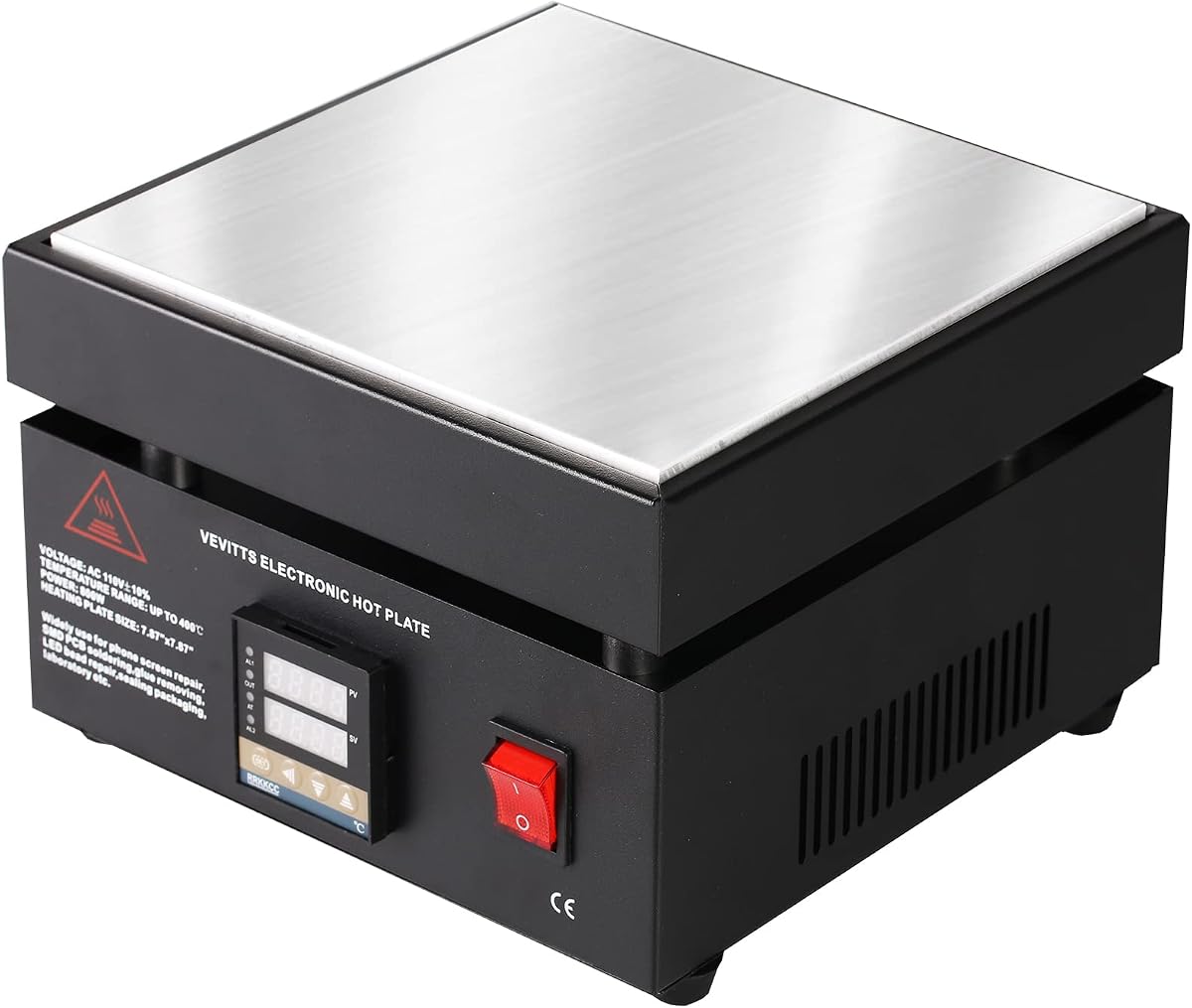
The Vevitts 110V 850W LED Digital Electric Hot Plate is a large, quiet platform suited to PCB, SMD, and LED rework in laboratories as well as on repair benches. Its 4.4 rating reflects a generally capable feature set: a 200 by 200mm aluminum alloy heating plate, an adjustable 30–400°C range, microcomputer temperature control, and 850W output.
We may earn a commission when you buy through this link, at no additional cost to you.
The fanless design distinguishes it from hot plates that use a cooling fan. Instead, three-sided ventilation holes provide heat dissipation while keeping operation quiet. A full heat-insulation wrap is intended to reduce accidental contact with hot exterior areas. Multi-tube heating technology supports relatively fast heat transfer and more uniform distribution across the broad plate.
The listing does not mention a dedicated calibration function or a fixture, so users who need independent adjustment or secure positioning should account for that. Its 110V rating may also make it less convenient for users outside North American-style electrical systems. As with any broad hot plate, the full square surface should be treated as hazardous while hot and during the cooling period immediately after shutdown.
This model is a good fit for users who value low noise and large-area heating more than advanced calibration. It can serve electronics engineers, LED technicians, researchers, and teaching institutions that want an all-purpose controlled-heating platform. It is particularly appropriate for a quiet workshop, where continuous fan noise would be distracting during detailed repair or laboratory work.
Three-sided ventilation replaces the need for a fan, helping keep noise low during long work sessions. Users should still maintain clear space around the vents so heat can dissipate properly.
The insulation wrap helps protect against accidental burns around the platform. It does not make the heated surface safe to touch, so tools and suitable protective procedures remain necessary.
We may earn a commission when you buy through this link, at no additional cost to you.
The SHP-1 Digital Lab Hot Plate is the broadest laboratory heating device in this roundup, but it carries an important limitation: both the supplied description and title state that it is not suitable for PCB reflow. Its 4.7 by 4.7-inch cast iron surface, 1KW heating capacity, and ability to reach 500°C make it more appropriate for glue curing, mold preheating, material testing, factory work, and research applications.
We may earn a commission when you buy through this link, at no additional cost to you.
The cast iron plate provides rapid and uniform heat transfer from room temperature to 500°C. A microcomputer controller and digital display maintain a stable temperature, with the supplied information indicating accuracy of plus or minus 1°C. Three-sided ventilation and a fanless design provide effective cooling with low noise, while heat-resistant insulation borders help reduce burn risk around the surface.
The textured cast iron finish is unsuitable for sensitive PCB reflow work and may not be ideal for delicate cosmetic surfaces. The model also has the lowest customer rating in this comparison at 3.9, which does not negate its strengths but should prompt careful consideration of the stated workload. It is also a general-purpose electric heater rather than a purpose-built electronics-rework platform.
This hot plate is worth considering for industrial, laboratory, or instructional heat tasks that do not involve reflowing circuit boards. Its high maximum temperature and strong thermal capacity make it useful for glue curing and material testing. Electronics technicians focused on soldering, SMD removal, or BGA rework should instead choose an aluminum or infrared platform expressly designed for those tasks.
A 500°C maximum and 1KW capacity support demanding thermal tasks beyond typical electronics work. Temperature selection should still be based on the material being heated and the manufacturer's safety guidance.
The textured cast iron surface is expressly unsuitable for PCB reflow. Users shopping for soldering repair equipment should treat that limitation as decisive rather than relying on the unit's general heating capability.
We may earn a commission when you buy through this link, at no additional cost to you.
Choosing a soldering hot plate requires balancing surface size, heating capacity, temperature control, electrical compatibility, cooling, and the type of repair work you perform. The most important step is to match the platform to the components and boards you actually handle rather than selecting solely by wattage or customer rating.
Heating area determines how much of a board or component can be warmed at once. A 100 by 50mm plate is appropriate for concentrated SMD and BGA work, while a 100 by 100mm surface offers a more balanced footprint for small and medium assemblies. Models with 200 by 200mm plates can handle phone screens, elongated boards, LED assemblies, and several components simultaneously. Larger surfaces are more flexible but demand more bench space.
Choose a plate at least large enough to support the intended workpiece without forcing it to overhang the heated area. Match the platform to the job, and favor a compact model for precise, small-component work.
Power indicates the heating capacity of the platform. The options here range from 210W to 1KW, with many dedicated repair models using 350W or 850W. Higher output can bring a broad surface to temperature more quickly, although actual performance also depends on the heating element, plate material, insulation, and power supply. General laboratory hot plates may provide greater thermal power because they serve different workloads.
Consider power alongside area rather than in isolation. A large plate with insufficient power may heat unevenly or slowly, while a compact plate does not always need maximum output. Select the rating that matches the size and thermal demands of your typical workpiece.
Most dedicated models offer a 30–400°C range, while the 853A begins at 50°C and the SHP-1 reaches 500°C. A broad range supports different soldering, rework, warming, drying, and material tasks. Digital displays, sensors, PID control, and CPU-based regulation are valuable because they provide clearer feedback and more consistent power adjustment than a simple unregulated or two-position switch.
Prioritize a readable display and an accurate temperature feedback system. Independent calibration is an added advantage for repeated long-term work. Choose a narrower or higher minimum temperature only when the extra range has no value for your work.
Voltage is a critical compatibility issue. Several models are explicitly designed for 110V, the 853A and WEP units are rated for North American 110–127V use, and the feature-rich 200 by 200mm digital station is specified for 220V. Connecting a unit to the wrong supply can damage it and create a safety hazard. Plug shape, circuit capacity, grounding, and the manufacturer's instructions should all be considered before use.
Check the listing for the exact input rating rather than assuming that all hot plates are interchangeable. If your available supply does not match, choose a model designed for that voltage instead of using an improvised adapter or unsupported converter.
Sustained heating creates heat around the chassis and heating element, so ventilation matters for stability and component longevity. The products use two-dimensional, three-dimensional, or three-sided cooling-hole arrangements, while the Vevitts and SHP-1 use fanless designs. Fans can improve active cooling but may add noise; passive ventilation keeps operation quiet but requires adequate space around the unit.
Look for unobstructed airflow, especially during extended repair sessions. If noise is important in a shared lab or quiet workbench, a fanless model with multi-sided ventilation may be preferable. Always allow the heated surface to cool before touching it.
Features such as temperature sensors, calibration controls, preheat cycles, metallic guards, anti-static surfaces, and adjustable workpiece holders can materially improve electronics rework. The 853A's four thumbscrews help secure boards of different sizes, while the WEP's millisecond PID programming supports precise SMD and BGA work. Heat-resistant edges and insulation wraps add protection around the hottest region.
Prioritize features that solve a recurring problem in your workflow. Secure positioning matters for irregular boards, calibration matters for repeatable results, and fast sensor feedback matters for delicate components. Avoid paying for complexity you will never use.
Aluminum plates are common on soldering hot plates because they transfer heat quickly and distribute it across the work surface. Stainless steel appears in the infrared model, while the SHP-1 uses textured cast iron. Cast iron can handle general high-temperature work, but its texture is unsuitable for PCB reflow. Surface condition also affects whether delicate parts can rest flat without marking or shifting.
Choose aluminum or stainless steel for electronics rework and reserve textured cast iron for industrial or laboratory heating. Confirm that the surface is smooth, flat, clean, and compatible with the components being assembled.
A readable control panel, simple menu structure, calibration support, and reliable technical assistance can make a platform easier to operate. The WEP unit includes one-year technical support, while other listings emphasize microcomputer controls and direct temperature settings. Application descriptions also help define the tool: dedicated soldering platforms are optimized for boards and components, whereas the SHP-1 is aimed at glue curing, mold preheating, and material testing.
Review the complete instructions and support terms before buying. A device that matches the intended workload and offers understandable controls is more valuable than a higher-powered model with features the user cannot confidently configure.
Before switching on the hot plate, read the model-specific instructions, verify the voltage and connector, and inspect the heating surface for damage, contamination, or corrosion. Place the unit on a stable, heat-resistant workbench with its ventilation openings unobstructed. Connect the appropriate power lead securely, select a suitable target temperature, and allow the plate to stabilize before placing a workpiece on it.
For electronics work, begin with a conservative temperature appropriate to the solder, adhesive, board material, and component sensitivity. Position the assembly flat and keep it stable using a safe holder or compatible fixture. Monitor the digital display and avoid leaving a board unattended during heating. Do not touch the heating surface, and do not place flammable items, solvents, or moisture-sensitive components near the hot area.
After the task, switch off the unit and allow the surface to cool naturally. Do not touch it immediately after shutdown, as the listing for several models specifically warns that residual heat can cause burns. Wipe only as directed by the manufacturer, avoid abrupt temperature shocks, and keep the vents clear of dust. Inspect cables and the surface regularly, use qualified support when electrical faults appear, and never bypass grounding or alter the voltage configuration.
A 100 by 100mm platform is a versatile choice for many small and medium PCBs because it can heat several nearby components without taking up excessive bench space. A 200 by 200mm model is more practical for larger boards, phone screens, and multiple assemblies. For concentrated BGA or SMD work, a smaller 100 by 50mm platform may provide a more focused working area.
No. Higher wattage can support faster heating across a larger surface, but power is only one part of the system. Heating-element design, plate material, insulation, temperature control, and the size of the workpiece all affect performance. A well-controlled 350W unit may be more suitable for a compact repair bench than an overly powerful general-purpose heater.
Several models are explicitly listed for SMD components, BGA chips, or both. The most compact platforms can provide bottom heat while a hot-air station heats from above. The 853A also includes an adjustable holder, which can help maintain board positioning during rework. Users should still match the temperature to the component and follow the board manufacturer's process guidance.
Most dedicated models in this guide cover 30–400°C, providing a broad range for soldering, preheating, adhesive removal, and controlled heating. General laboratory models may reach 500°C, while a 50°C minimum can be too high for certain low-temperature warming tasks. The useful choice depends on your materials and processes rather than the highest available number alone.
No. A 110V or 110–127V unit should not be connected directly to a 220V supply unless the manufacturer explicitly authorizes another configuration. The 220V model in this roundup should likewise be checked against the outlet and circuit requirements. Using the wrong voltage can damage the controller or heating element and create a fire or shock risk.
No. The SHP-1 in this roundup is explicitly unsuitable for PCB reflow because of its textured cast iron surface. General laboratory heaters may also lack the flatness, temperature response, or control needed for electronics work. Choose a model whose listing specifically states suitability for soldering, PCB rework, SMD removal, or BGA work.
Treat the entire heating surface as hot during operation and for some time after shutdown. Keep hands away from the plate, use a suitable tool for moving small parts, and avoid flammable materials nearby. Heat-resistant borders and insulation can reduce accidental contact, but they do not make the platform safe to touch. Let the surface cool before cleaning or storage.
PID control is valuable when repeatable temperature and quick correction of heat loss are important. It helps the controller adjust power continuously rather than relying only on a simple on-off cycle. Models with sensors, digital displays, and calibration can be especially attractive for repeated board work, although a less complex unit may still be adequate for occasional or straightforward tasks.
The strongest overall choice is the Digital 200x200mm Preheat Station because it combines a large multi-point heating surface, a 4.8 customer rating, digital sensor feedback, and independent calibration. The Compact Digital PCB Preheater is the best budget-oriented option for compact 110V electronics work, while the WEP 946D IV is the premium pick for precise SMD and BGA tasks requiring PID programming.
Prioritize the workload before the specification sheet. Choose a large plate for screens and expanded boards, a compact surface for small components, and a fixture-equipped model when secure positioning matters. Also check voltage, temperature range, cooling, and whether the listing explicitly supports the intended electronics process. The SHP-1's suitability for general laboratory heating does not translate into PCB-reflow capability.
Customer ratings and supplied specifications can help narrow the field, but the current listing and manual remain the final authority for specifications, included accessories, safety notices, and compatibility. Prices and availability can change at any time, so review the current product page before buying and choose the model that best matches your actual repair or heating tasks.