
ZhiYo 4ft Floor Cord Cover
4.6Editor score
One or two smaller cables
Includes strong adhesive tape
Low-profile flexible PVC
An Ethernet cable floor cover keeps network cables, extension cords, speaker wires, and power strips concealed while creating a smoother path across busy rooms. The most useful model has enough channel space for your cables, stays securely positioned, resists repeated foot traffic, and can be trimmed to fit the available space without leaving exposed edges.
This guide compares ten floor cord covers based on their published dimensions, channel capacity, material, installation method, and intended applications. It includes narrow single-cable channels, wider dual-cable profiles, and heavy-duty multi-channel designs for homes, offices, gaming areas, workshops, warehouses, exhibitions, and other cable-heavy environments.
Each pick highlights a different balance of channel size, length, flexibility, and holding power, while the buying guide explains how to measure cables and select a suitable floor profile. Ratings and availability can change over time, and current prices should be checked before purchasing, so compare the latest listing details with your installation needs.
4.6Editor score

4.6Editor score

4.7Editor score
As an Amazon Associate we earn from qualifying purchases.
The comparison below shows the principal differences in length, channel capacity, installation, and intended use, making it easier to identify the floor cover that fits a particular cable bundle and location.




The D-Line 6ft Floor Cord Cover combines a useful two-cable cavity with a practical six-foot length, making it a strong all-purpose choice for hiding Ethernet and power cables. Its 4.6 rating reflects a favorable balance of construction, installation convenience, and cable-holding performance. The flexible PVC profile is designed to lie flat rather than remain tightly curled after unpacking.
We may earn a commission when you buy through this link, at no additional cost to you.
A major advantage is the 0.63-inch-wide by 0.31-inch-high channel, which can accommodate up to two cables measuring 0.31 inches in diameter. That makes the model more versatile than a very narrow single-wire channel. The ribbed base is intended to resist sliding, while the pre-split rear allows the cover to be opened and placed over cables without applying adhesive tape.
There are some trade-offs. The six-foot roll is shorter than the ten-foot options in this guide, so installations crossing a room may need multiple pieces. The beige color is also more visible on dark flooring than a black model, although its neutral tone can blend well with lighter commercial and domestic surfaces. The cavity still needs to be measured against thicker Ethernet cable jackets.
This is a strong recommendation for someone who wants a moderate-width floor cover for one Ethernet cable plus another thinner wire, especially in an office, classroom, gaming room, or home. Choose it when cable capacity, easy trimming, and dependable floor contact matter more than obtaining the longest possible roll in a single piece.
The cavity can hold up to two cables with diameters of 0.31 inches, providing enough room for a typical Ethernet run and a smaller power or speaker wire without creating a bulky exposed crossing.
Its pre-split rear and ribbed non-slip base make placement straightforward. Tape is not listed as a required part of installation, which can be convenient when repositioning the cover or avoiding residue on the flooring.
We may earn a commission when you buy through this link, at no additional cost to you.
The ZhiYo 4ft Floor Cord Cover is an economical, compact solution for a single Ethernet cable or two smaller wires. It carries a 4.6 rating and offers a 0.6-inch-wide by 0.32-inch-high cavity, giving it more room than the narrowest covers in the guide. Its low-profile design is intended to reduce snagging and allow rolling traffic to pass over it.
We may earn a commission when you buy through this link, at no additional cost to you.
This cover is supplied with a roll of strong adhesive tape, giving the installer an optional way to secure it more firmly. The non-slip base also supports placement without tape, so users can choose according to the flooring and the need for repositioning. Scissors can shorten the profile, and the half-sealed rear can be opened with a utility knife to expose the channel.
The main limitation is cable diameter. The concealed cable must measure less than 0.37 inches, which is enough for many Ethernet cables but may not accommodate a bulky power cord, thick braided cable, or several connectors positioned directly beneath the cover. Its four-foot length also makes it best for localized crossings rather than a full-room run.
This is a sensible budget pick for homes, offices, and event spaces where a black Ethernet cable or a pair of slim cables crosses a walking path. Measure the cable first, then choose this model if its cavity is sufficient and the included adhesive is appropriate for the surface.
The cavity is designed for either one extension cord up to 0.37 inches thick or two standard cables around 0.28 inches each, making it a flexible choice for compact cable bundles.
The non-slip base can remain freestanding, while the included tape provides additional fixation on suitable floors. This gives users flexibility when the cover may need to be moved or cleaned.
We may earn a commission when you buy through this link, at no additional cost to you.
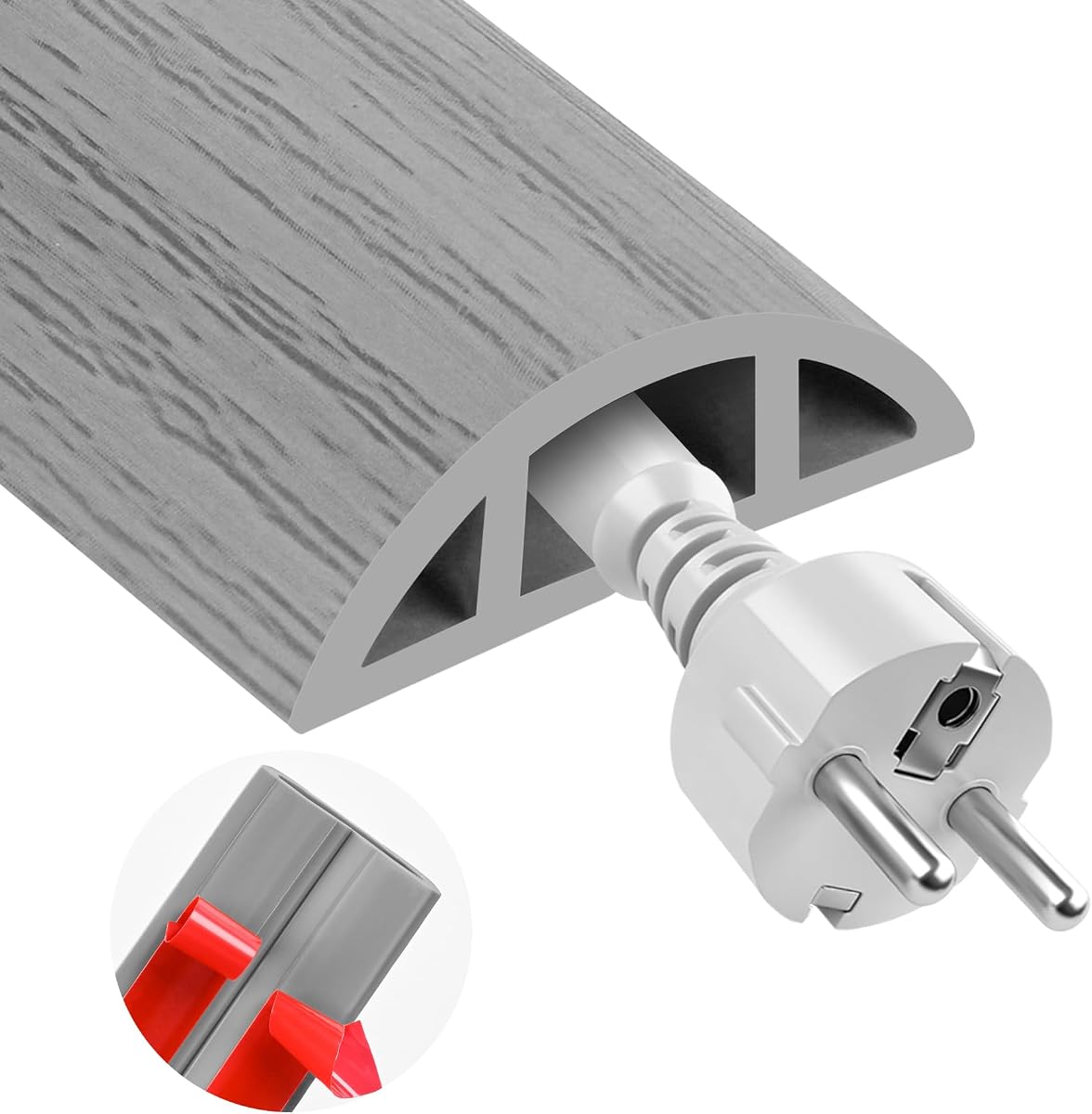
This ten-foot self-adhesive cord hider is designed around a single Ethernet, speaker, or extension cable rather than a large bundle. Its 4.4 rating reflects a practical product with a narrow 0.39-inch by 0.27-inch channel. The gray wood appearance is intended to blend into a range of domestic and commercial interiors.
We may earn a commission when you buy through this link, at no additional cost to you.
Installation is straightforward: place the cable in the channel, remove the backing film, and press the cover onto the floor. Scissors can be used to shorten it for a precise fit. The flexible PVC is described as abrasion resistant and easy to wipe or wash, while the curved profile helps reduce the chance that someone will catch a foot on the cable.
The tradeoff is capacity. The channel must accommodate one cable with a diameter below 0.27 inches, so a thick Ethernet jacket, multiple cables, or a full-size power strip may not fit. The adhesive is also central to the design, which may be less appealing on a surface that should not receive adhesive residue or where the cover must be moved frequently.
This model works well for a single network cable crossing a home office, gaming area, classroom, or gym. It is a particularly good match when one continuous ten-foot run is needed and the cable fits within the stated 0.27-inch limit.
The narrow cavity is specifically suited to one Ethernet or speaker cable, helping remove visual clutter without creating a wide obstacle across the walking route.
A single ten-foot profile can simplify longer installations that would otherwise require multiple shorter covers, reducing the number of visible joins along a wall or walkway.
We may earn a commission when you buy through this link, at no additional cost to you.
The 4FT Brown Floor Cord Cover is a compact option centered on concealing one relatively thick extension cord or a smaller group of cables. Its 4.6 rating and straightforward construction make it appealing for short crossings. The soft PVC body is flexible enough to trim and is designed to create a smooth, unobtrusive surface.
We may earn a commission when you buy through this link, at no additional cost to you.
The internal channel measures 0.47 inches wide by 0.24 inches high, and the manufacturer says it can hide a power cord measuring up to 0.43 inches in diameter as well as Ethernet, speaker, and extension cables. The outer profile is two inches wide and 0.4 inches high, creating a broader surface than the very slim single-cable models.
Installation requires allowing the rolled cover to relax for approximately 15 minutes before laying it flat. Adhesive tape is included for securing it to smooth, clean floors, although the cover can also be positioned by its profile. The most significant limitation is its four-foot length, and the shallow 0.24-inch channel should be checked against the actual cable thickness.
Choose this model for a short, clearly defined cable crossing in a home, office, warehouse, classroom, trade show, or gaming room. It works especially well when the visual goal is to hide one thick cable rather than create a broad multi-cable organizing lane.
Unlike many narrow channels, the 0.47-inch-wide cavity is designed to accommodate a comparatively thick extension cord, which is useful near desks and equipment stations.
The soft PVC can be cut to the needed length with basic tools, allowing users to match a short crossing precisely and avoid excess material extending beyond the cable route.
We may earn a commission when you buy through this link, at no additional cost to you.
The ZhiYo 4ft Cord Covers for Wires on Floor is a compact, single-cable model for concealing an Ethernet line, speaker wire, or power strip lead. Its 4.4 rating reflects a well-defined purpose: creating a smooth route over one cable. The black finish also blends more readily with dark electronics and entertainment furniture.
We may earn a commission when you buy through this link, at no additional cost to you.
The channel measures 0.47 inches wide by 0.28 inches high, and the cable diameter must be below 0.28 inches. The cover is made from thick but soft flexible PVC, with a rounded exterior that is designed to let wheels cross it without catching. A split backing can be opened with a utility knife, and the cover can be cut with scissors.
Installation relies on the included adhesive tape for securing the cover, which is helpful for maintaining a consistent path but worth considering on delicate flooring. The product is only four feet long and is intended for one cable rather than a broad bundle. The relatively shallow cavity is also less forgiving than the dual-cable or multi-channel choices.
This is a practical pick for a discrete single Ethernet run near a television, desk, entertainment console, or workstation. Buy it when appearance and a compact footprint matter, and confirm that the cable diameter and floor surface are compatible before installation.
The narrow black profile can hide a lone network cable while blending into dark furniture, desks, and media cabinets, helping keep gaming and viewing areas visually tidy.
Its rounded exterior is intended to reduce snagging and permit chairs, carts, and other rolling equipment to move across the covered route with less interruption.
We may earn a commission when you buy through this link, at no additional cost to you.
The LSGCQ Floor Cord Cover Self Adhesive Cord Hider is a flexible option for installations where cables need to disappear along a floor or wall edge. It holds a 4.4 rating and focuses on simple placement, a smooth profile, and the ability to cut the cover to the dimensions required by a particular room.
We may earn a commission when you buy through this link, at no additional cost to you.
Its strong adhesive backing can be applied to hardwood, tile, carpet, and other listed surfaces. Users cut the desired length, position the wire in the channel, and peel away the backing film before pressing it into place. The low-profile surface is designed to reduce obstruction and let wheels roll over the cable more easily.
Unlike several other products in this list, the supplied information does not state exact internal channel dimensions or the maximum cable diameter. That makes careful measurement and a review of the current product listing especially important. The permanent-adhesive approach may also be inconvenient if the cable layout is likely to change or if the flooring is delicate.
This cover is a good candidate for workshops, offices, homes, warehouses, and wall-edge cable routes where a low-profile appearance and simple adhesive installation are priorities. It is best suited to users who can confirm the channel size from the latest listing details before purchasing.
The ability to attach the cover to a floor or wall edge makes it useful for routing a network cable beside furniture, baseboards, workstations, and equipment where a centered walkway is less practical.
A smooth surface and understated shape help the cover blend into the surrounding area, reducing the visual impact of exposed wiring in offices, homes, and commercial rooms.
We may earn a commission when you buy through this link, at no additional cost to you.
The MYFAMIREA 10FT Floor Cord Cover combines a ten-foot length with an adhesive-backed PVC profile for a broad range of household and commercial settings. Its 4.4 rating reflects a versatile installation approach and a textured gray wood finish. The cover is aimed at hiding a single larger wire, including an Ethernet cable or extension lead.
We may earn a commission when you buy through this link, at no additional cost to you.
Heavy-duty tape is included to maintain adhesion, and the cover can be applied to wood, marble, tile, carpet, metal, and other listed surfaces. The surface should be dry before placement. Its flexible design allows trimming to the desired length, while a hair dryer can be used in cold weather to improve flattening and adhesion.
The manufacturer advises that only one larger wire should be accommodated, so this is not the right choice for a broad cable bundle. Adhesive-backed products also require more confidence in the final route than a non-slip freestanding profile. The listed outdoor use should be understood as suitability for covered or suitable external conditions rather than a guarantee of permanent weather resistance.
This model is well suited to a home office, garage, workshop, gymnasium, warehouse, or concert area where a long cable path must blend into several different floor materials. It offers a good combination of length, flexible placement, and surface versatility for installers who know where the final route will run.
The cover is listed for wood, marble, tile, carpet, and metal, making it useful in mixed spaces where a standard flooring tape may not provide an equally secure result.
The manufacturer notes that gentle heat from a hair dryer can help restore the profile and improve adhesion in cold weather, which is useful when a coiled cover does not initially relax.
We may earn a commission when you buy through this link, at no additional cost to you.
The Eapele 10 ft Floor Cord Cover is the most substantial multi-cable option in this guide and carries the highest published rating at 4.7. Its deep, large channel can route at least five standard-sized cables, making it well suited to a desk with several network, power, and peripheral connections rather than a single Ethernet lead.
We may earn a commission when you buy through this link, at no additional cost to you.
The cover measures 10 feet long, 3.03 inches wide externally, and 0.75 inches high. Heavy flexible PVC gives the profile enough substance to resist curling after unrolling while retaining the ability to be cut with a knife or scissors. Once laid flat, its weight helps it remain stable, and the large surface can conceal a substantial bundle of wiring.
The wider profile occupies more floor space than a slim single-cable cover and may be more noticeable in a narrow passage. Because the exact cavity dimensions are not provided in the supplied information, buyers should confirm the space needed for their cable bundle and check the latest listing. The larger footprint may also be excessive for a single thin Ethernet cable.
This premium cover is an excellent fit for home offices, workshops, warehouses, concerts, gaming setups, and busy rooms with several cables crossing one route. Choose it when high capacity and stable coverage matter more than minimal width, especially in locations with pets, children, or frequent foot traffic.
A channel for at least five standard-sized cables provides room to organize Ethernet, power, speaker, and peripheral wires together instead of placing several narrow covers beside one another.
The heavy flexible PVC is designed to resist persistent curling, while the profile's weight helps it remain in position after being unrolled and fitted into a busy cable route.
We may earn a commission when you buy through this link, at no additional cost to you.
The Legrand Wiremold Corduct 5 Foot Over Floor Cord Cover offers a recognizable cable-management option for concealing cords in indoor spaces. Its 4.3 rating is slightly lower than many products in the guide, but the model is supported by the established Wiremold name and is presented as a simple solution for creating a smoother route over exposed wiring.
We may earn a commission when you buy through this link, at no additional cost to you.
Pressure-sensitive tape is included on the backing and can be applied to indoor flooring. The profile can be shortened with scissors or a utility knife, allowing the installer to fit it around furniture, wall-mounted televisions, desks, and other fixed equipment. Its low-profile design is intended to protect cords while reducing the visible and physical obstruction they create.
The primary limitation is that the product information focuses on indoor flooring rather than outdoor use. Its five-foot length is also shorter than the ten-foot covers, so larger installations may require more than one piece. Buyers should also verify the internal cavity size and the diameter of the Ethernet cable before ordering, as exact channel dimensions are not listed.
This is a sensible pick for homeowners and installers who value an established brand, a straightforward tape-backed installation, and the ability to trim the cover to a custom length. It is especially relevant around wall-mounted televisions and home office furniture where a neat, low-profile cable route is needed.
The cover was specifically presented as a way to conceal TV cords for wall-mounted televisions, helping reduce visual clutter around mounted displays and nearby furniture.
Pressure-sensitive adhesive and tool-free trimming make the profile straightforward to install in an indoor room, provided the flooring is clean, dry, and compatible with the backing.
We may earn a commission when you buy through this link, at no additional cost to you.
The 10FT Floor Cord Cover for Wires uses three separate channels to organize a more complex cable arrangement. It has a 4.6 rating and stands apart from ordinary single-channel floor profiles by keeping the center cable separate from two smaller side channels. The result is an organized lane for Ethernet, power, speaker, and extension cables.
We may earn a commission when you buy through this link, at no additional cost to you.
The center cavity measures 0.94 inches wide by 0.4 inches high, while each side channel measures 0.75 inches wide by 0.35 inches high. This arrangement accommodates one larger center cable alongside smaller runs. Installation involves unrolling the cover, allowing it to flatten, cutting along the rear groove, placing the wires into the channels, and trimming the profile to fit.
Because there are three separate cavities, the cover is wider and visually more substantial than a slim one-channel model. The different opening sizes also require attention when assigning cables to each section. It is important not to force a cable into a smaller side channel merely because the three openings are visible in the same profile.
This model is a strong choice for a home office, bedroom, garage, workshop, patio, or courtyard where several cables need to follow the same route without being bunched together. The yellow warning stripes improve visibility in busy work areas, while the textured lines add traction for people and wheels crossing the cover.
Separate channels prevent an Ethernet cable, a power lead, and a smaller speaker or extension wire from being forced into a single crowded opening.
Textured anti-slip lines support footing and rolling traffic, while bright yellow warning stripes make the covered route easier to notice in offices, garages, and work areas.
We may earn a commission when you buy through this link, at no additional cost to you.
The right floor cover depends primarily on cable thickness, bundle size, route length, floor material, and traffic level. Measuring the installation before comparing profiles prevents a common mistake: buying an attractive cover whose channel is too small or whose adhesive is unsuitable for the intended surface.
Cable diameter is the most important measurement because the internal channel must be larger than the thickest section of the cable, including any connector that remains beneath the cover. The covers in this guide specify different maximum sizes, ranging from approximately 0.24 inches to 0.4 inches in height, so a thin patch lead and a substantial braided Ethernet cable may require entirely different models. Measure the cable at several points and use the largest result.
A single-cable channel can be visually cleaner and less intrusive, but it is ineffective when several Ethernet, power, and speaker wires must cross the same path. Dual-cable covers may accommodate one thicker cable plus one thinner cable, while larger deep-channel or three-channel designs can organize full bundles. Some products specify individual openings, whereas others describe a shared cavity, so check whether the stated capacity refers to cable diameter or the number of wires.
The outer width and height determine how much floor space the cover occupies and how noticeable it will be. Narrow covers fit neatly beside furniture or along wall edges, while wide heavy-duty profiles offer greater capacity but can create a larger raised path. Compare both the external dimensions and the internal cavity, and consider whether people will cross the route frequently or mainly walk parallel to it.
Adhesive-backed covers are convenient for permanent routes and usually offer strong initial fixation, but removal may be more difficult and some surfaces are less suitable for adhesive. Non-slip or ribbed bases can be positioned more freely and are useful where the cable layout may change. Whichever method is chosen, clean and dry the flooring before placement, and follow the manufacturer's surface guidance.
Four-foot covers suit short crossings, five-foot products work well for furniture and television installations, and ten-foot profiles can simplify longer runs. A single long cover usually has fewer visible joints than several short sections, but it may be overkill for a small crossing. Measure the route, add enough overlap for any turns, and remember that a cover can be trimmed after purchase.
Busy doorways, offices, warehouses, gyms, and exhibition spaces require a cover that remains stable under repeated foot or wheel traffic. Look for a low profile, rounded surface, non-slip base, and sufficient material weight. Wider heavy-duty covers are more likely to stay in place, while adhesive-backed models benefit from careful pressure along the entire strip. The cover should also avoid creating a raised edge that can catch a foot or caster.
Flexible PVC is used across most of the market because it is lightweight, cuttable, and easy to wipe clean. It may scuff in harsh environments, so a heavier profile can be preferable where equipment rolls over it repeatedly. Check whether the surface can be washed, and avoid leaving trapped dirt inside the channel because the rear split can make the interior difficult to access.
Black covers tend to disappear against dark floors, neutral colors can blend with light interiors, and wood-patterned finishes may blend with natural flooring. In a high-visibility work zone, warning stripes or contrasting colors can help users recognize the covered route. Regardless of color, the cover should reduce the prominence of the cable without creating a new obstruction or claiming that it eliminates all trip risk.
Begin by unrolling the cover and allowing it to relax until it lies flat. If the profile remains curled, reverse the roll and let it settle again; some manufacturers also recommend gentle warming with a hair dryer in cool conditions. Measure the route, mark the desired ending point, and use a sharp utility knife or sturdy scissors to cut cleanly without damaging the internal channel.
Open the rear split where necessary, position the Ethernet cable and any additional permitted wires inside their channels, and close the cover over the cables. Place the cover before applying adhesive, then press firmly along its length so that it bonds evenly to a clean, dry floor. For a non-slip model without tape, align it carefully and check that its base is resting evenly rather than twisted.
Inspect the cover periodically, especially around connectors and transitions. Lift the cover before vacuuming or washing the area, clean the exterior with a damp cloth, and keep the channel free of dust. Replace or reposition adhesive covers if the edges begin to lift, and never force a cable or connector into a channel that is too narrow.
Most standard Ethernet cables fit a cover with an internal channel at least 0.27 inches high, but the correct answer depends on the cable jacket and any connector that remains underneath. Measure the thickest point before ordering, then leave a little clearance. Thicker braided or armored Ethernet cables may require the larger 0.31-inch, 0.35-inch, 0.4-inch, or deeper channels listed by certain products.
Yes, if the product has sufficient internal capacity. Some single-cavity covers can hold one cable and one smaller wire, while deep-channel models may accommodate at least five standard-sized cables. A three-channel design separates cables into individual openings. Check the published channel dimensions and avoid interpreting a shared cavity description as permission to force in more wires than the product can safely hold.
Adhesive-backed covers suit permanent routes and can provide firm placement, while non-slip covers are easier to move and may be preferable for temporary setups. Adhesive performance varies with the floor material, and residue can be difficult to remove from some surfaces. Clean and dry the area before installation and use the method best aligned with how often you expect to reposition the cable.
Several products in this guide are listed for use on carpet, and their low profiles can make a cable crossing more manageable. The quality of adhesion or friction depends on the carpet pile and the cover's base. Test a short section first, particularly in high-traffic areas, and make sure the cover rests flat without bending the carpet or creating a curled edge.
Most flexible PVC profiles can be trimmed with a sharp utility knife or sturdy scissors. Measure carefully before cutting, and work from one end so the remaining profile does not become compressed. The supplied information for some products does not provide complete internal dimensions, so verify the latest listing and test the cable fit before permanently fixing the cover.
Unroll the cover, reverse the direction of the original roll, and allow it to rest on a flat surface. Some models flatten without boiling water or other added heat. The MYFAMIREA description also notes that gentle warming with a hair dryer in cold weather can help restore flatness and improve adhesion, provided the material is handled carefully.
Some products are explicitly listed for indoor or outdoor settings, including patios, courtyards, garages, and exterior work areas. Outdoor suitability does not mean every cover is permanently weatherproof. Check the product details, installation surface, expected exposure, and local conditions, and avoid creating a route where water, dirt, or debris could collect inside the channel.
Select a channel slightly larger than the cable but not so loose that the wire can move toward an opening. For multiple cables, use separate channels when possible and place them neatly before closing the rear split. If the cover shifts under traffic, secure it with its intended adhesive system or choose a heavier profile with a stable, ribbed, or non-slip base.
The D-Line 6ft Floor Cord Cover is the strongest all-around selection because it combines a useful two-cable cavity, a ribbed non-slip base, and easy trimming. The ZhiYo 4ft Floor Cord Cover offers an efficient option for one or two smaller cables and includes tape, while the Eapele 10 ft Heavy Duty Cover is the premium choice for larger bundles and busy environments.
Before purchasing, measure the cable diameter, count the wires, and compare the channel openings with the available floor space. Consider whether the route needs permanent adhesive or a movable non-slip base, and select a length that fits without leaving excess material. For complex installations, a three-channel or broad heavy-duty model can provide a cleaner and more durable result.
Ratings, product availability, and prices can change, so check the current listing before making a final decision. Compare the latest dimensions and included installation materials with your specific Ethernet cable and flooring, and choose the model that offers the required capacity without creating an unnecessarily wide obstacle.