
OSD Audio Nero HTA7200
4.6Editor score
Seven channels of Class AB
Balanced XLR and RCA inputs
Per-channel status monitoring
Explore the best 7 Channel Amp for Car and Home Audio, comparing seven-channel amps for power, control, connectivity, protection, and installation needs.
A 7-channel amplifier can simplify complex audio systems by combining multichannel speaker amplification with dedicated subwoofer power in one enclosure. That makes it especially useful for car sound upgrades and home theaters where space, wiring, and system integration matter. The right model also provides the filtering, gain controls, protection, and remote functions needed for accurate everyday listening.
This guide compares ten products that include genuine seven-channel models as well as closely related five- and six-channel amplifiers capable of supporting multichannel car or home setups. We evaluated each option using its stated channel configuration, output capabilities, crossover flexibility, input selection, monitoring features, physical design, and intended installation environment. The list shows why no single amplifier suits every room, vehicle, or speaker plan.
Each pick highlights the strongest use case for that amplifier, from sophisticated home-theater integration to compact car installations and high-output subwoofer performance. Ratings reflect the customer feedback supplied for each product, while specifications come from the available product information. Availability, configurations, and prices can change, so confirm the current details before purchasing.
4.6Editor score
5.0Editor score
5.0Editor score
The comparison below highlights each amplifier's channel flexibility, output, filtering, connectivity, and strongest application. It also distinguishes dedicated seven-channel home and car models from versatile five- and six-channel alternatives.




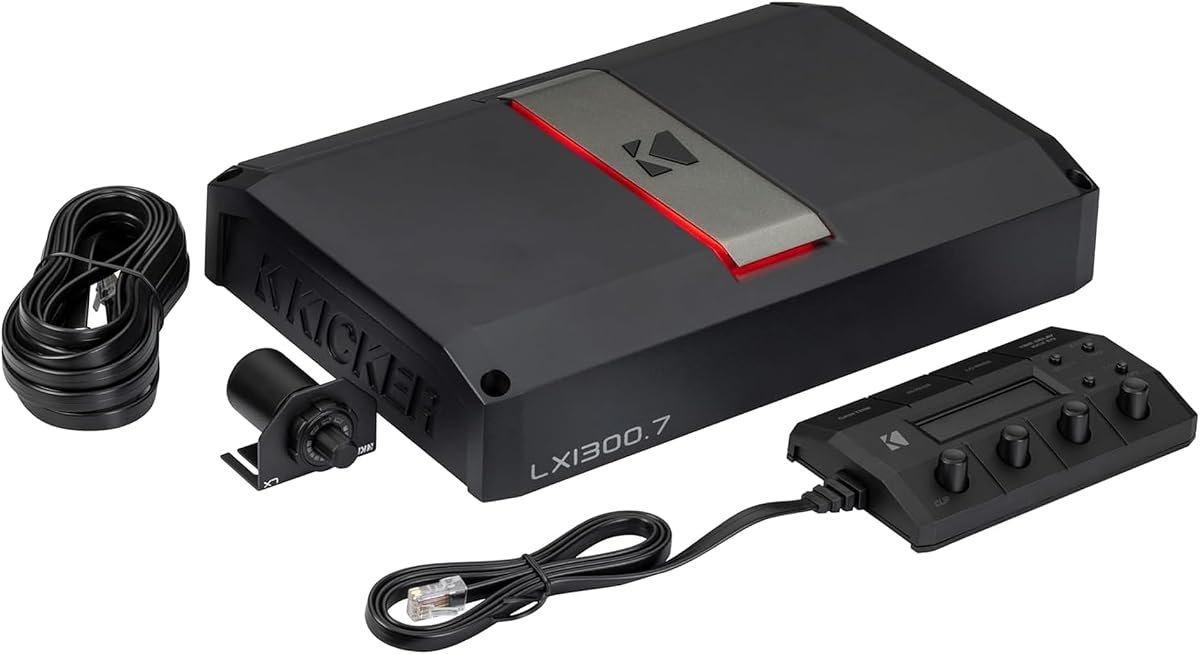
The Kicker LX1300.7 earns the Editor's Choice position because it combines seven-channel versatility with unusually complete system management. Its 5.0 customer rating reflects a product that appears to satisfy users looking for powerful full-range amplification, dedicated bass output, and convenient control. The unusual ability to accept signals up to 40 volts also makes it relevant to installations with substantial signal voltage.
We may earn a commission when you buy through this link, at no additional cost to you.
Its architecture is unusually practical for a large car system. Four channels are rated at 150 watts each into two ohms, two additional channels provide 65 watts each into two ohms, and the seventh channel delivers 700 watts into one ohm for a subwoofer. That arrangement can cover front and rear speakers, additional midrange or tweeter channels, and a serious subwoofer without requiring several separate amplifiers.
The included LX Control Center adds real-time visibility into battery voltage, amplifier temperature, and protection status, while supporting gain and crossover adjustments. The separate LX Remote Control makes bass changes convenient from the driver area. SHOCwave2.0 digital bass restoration is another useful feature, although it should be treated as tonal enhancement rather than a substitute for properly designing the subwoofer enclosure and speaker.
The trade-off is complexity. A seven-channel amplifier with multiple control accessories may feel excessive for a simple stereo-plus-subwoofer system, and installers must follow the channel map and wiring guidance carefully. Even so, for a car build that wants extensive power, centralized control, and fewer separate boxes, the LX1300.7 is the most complete choice in this guide.
The five full-range output channels plus two dedicated subwoofer channels provide unusual freedom for complex car audio. This layout supports front and rear speaker groups, additional tweeters or midrange drivers, and a separate subwoofer within one coordinated amplifier.
The LX Control Center lets installers or users monitor voltage, temperature, and protection conditions. The LX Remote Control adds everyday convenience by making subwoofer level changes accessible without repeatedly reaching into the cabin.
We may earn a commission when you buy through this link, at no additional cost to you.
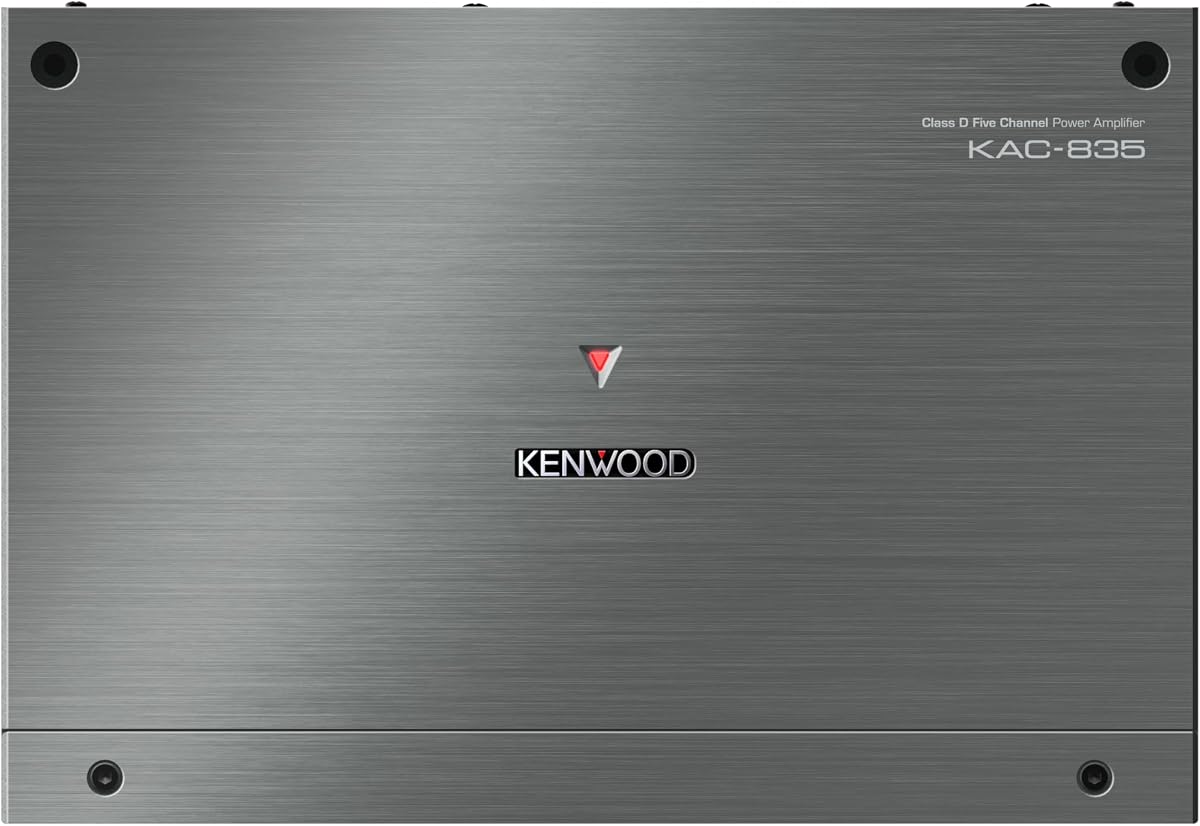
The KENWOOD KAC-835 combines a five-channel format with a 5.0 customer rating, making it an attractive value-oriented option for multichannel car audio. Its Class-D design targets efficient operation, while the output specifications show enough flexibility for four full-range speakers and a dedicated subwoofer channel. It is not a literal seven-channel amplifier, but it covers many practical system layouts with less complexity.
We may earn a commission when you buy through this link, at no additional cost to you.
The listed output includes 75 watts by four at four ohms, 50 watts by four plus 300 watts at four ohms, and 75 watts by four plus 500 watts at two ohms. The maximum output is stated at 1,600 watts, although maximum ratings should not be treated as the same as continuous output into a specific speaker load. The dedicated fifth channel is the key feature for users who want bass without a second amplifier.
Adjustable high-pass and low-pass filters, subsonic filtering, and gain controls make the KAC-835 easier to integrate with an appropriate source. Its high-resolution audio certification indicates attention to detail and frequency handling, while the wired remote provides convenient control of subwoofer level from the driver's position. These are the kinds of details that matter more in daily use than a headline power figure alone.
Its main limitation is channel count. Buyers who require independent amplification for five full-range channels plus two bass channels will need a true seven-channel model. For a common four-speaker-plus-subwoofer installation, however, the KENWOOD is focused, capable, and unusually approachable, making it the strongest budget-oriented recommendation here.
Class-D efficiency helps the amplifier manage heat while providing four multichannel outputs and a separate subwoofer channel. This makes the unit well suited to installations where one clean amplifier should replace separate front, rear, and subwoofer power stages.
High-pass, low-pass, subsonic, and gain adjustments give installers the tools needed to match different speaker types. The included wired remote keeps the most frequently changed control, subwoofer level, within convenient reach.
We may earn a commission when you buy through this link, at no additional cost to you.
The Outlaw Model 7000x is built around seven channels rated at 130 watts each, giving it a clear identity among the products in this guide. Its 4.7 rating suggests strong customer satisfaction, particularly for buyers who value balanced connectivity and channel-level engineering. It is particularly relevant to professional-looking installations where noise control and isolated channel sections matter.
We may earn a commission when you buy through this link, at no additional cost to you.
Both balanced XLR and RCA inputs are available. The XLR connections use common-mode rejection, while the differential-sensing RCA input circuit is designed to suppress hum when unbalanced sources are used. That gives the amplifier more flexibility than a model designed around only one input style, particularly when linking it with consumer preamps, professional mixers, or home-theater processors.
The internal design emphasizes isolation. Each of the seven channels has independent power-supply rectification, and the modular channel architecture keeps each audio signal isolated from the others from input to output. Separate output protection relays can disconnect an individual speaker if a short circuit or excessive DC offset is detected. These are meaningful reliability features in a high-power installation.
The main challenge is understanding how the seven output channels are intended to be deployed. A buyer looking for five conventional full-range channels plus two subwoofer outputs may not find the layout as immediately intuitive as a conventional 5.1-style amplifier. For installers who understand the design and value balanced audio, the Model 7000x remains an excellent choice for either car or home use.
XLR and RCA inputs make the amplifier compatible with both balanced and unbalanced source equipment. Separate rejection techniques in each input path help preserve a clean signal and reduce the chance of audible hum.
Independent rectification and isolated modular channel sections reduce unwanted interaction. Individual output relays provide a further layer of protection when a connected speaker develops a fault.
We may earn a commission when you buy through this link, at no additional cost to you.
The DOWN4SOUND JP77 is the most bass-focused option in the guide, with seven channels, 3,000 watts of stated RMS output, and a dedicated 2,000-watt RMS output at one ohm. Its white gloss enclosure may also appeal to builders who want the amplifier to blend into a visible installation rather than disappear inside a cabinet.
We may earn a commission when you buy through this link, at no additional cost to you.
The feature set emphasizes the subwoofer channel, which makes sense for car sound systems where a powerful, flexible low-frequency stage is a central objective. Its total output specification is impressive, and bandpassable crossovers provide useful control when a subwoofer is integrated into a more specialized multi-speaker arrangement.
This amplifier also includes high-quality RCA cables, reducing the need for a separate cable purchase when building the signal chain. The stated intention of consistent daily operation is encouraging for a product expected to handle repeated use, although long-term reliability should be judged through independent owner feedback rather than marketing language alone.
The most important limitation is the absence of a supplied customer rating. With limited published detail, the JP77 is best considered a high-output specialist rather than the safest universal recommendation. Buyers should confirm continuous channel ratings, impedance requirements, speaker-wire terminals, and protection features before committing to an installation.
The 2,000-watt RMS mono specification gives the JP77 a clear identity in bass-heavy car systems. That output should still be matched carefully to the subwoofer's impedance rating and enclosure design to obtain reliable results.
Bandpassable crossover controls add flexibility for specialized speaker arrangements. Included RCA cables provide a convenient starting point for connecting the amplifier to a compatible source.
We may earn a commission when you buy through this link, at no additional cost to you.
The OSD Audio Nero HTA7200 is a purpose-built seven-channel home-theater amplifier rather than a car amplifier adapted to several roles. With a 4.6 customer rating and a five-year warranty, it stands out for integration features and long-term confidence. Its seven channels are rated at 210 watts into four ohms or 145 watts into eight ohms with all channels driven.
We may earn a commission when you buy through this link, at no additional cost to you.
The connection options suit a wide range of home systems. Balanced XLR inputs are included for low-noise operation, while RCA inputs offer compatibility with ordinary consumer receivers and preprocessors. A 12-volt trigger allows the amplifier to turn on and off with the rest of a home-theater system, removing the need to manage power manually.
Per-channel status LEDs show whether each output is on, in standby, or in protection. This visibility is helpful during setup and troubleshooting, particularly in a rack or cabinet where a channel fault might otherwise be difficult to locate. The stated signal-to-noise ratio reaches 110 dB at full power and 105 dB at one watt, indicating a design intent focused on quiet background noise and dynamic range.
Class AB topology favors a traditional sound and substantial power delivery, but it generally consumes more electricity and produces more heat than a digital Class-D design. That makes the HTA7200 most suitable for a dedicated home installation with stable mains power and adequate ventilation. For a serious seven-channel theater, it is one of the most complete choices in the guide.
Seven simultaneous outputs support a full home-theater layout without scattering amplification across multiple enclosures. The 12-volt trigger and standby status make the amplifier easier to incorporate into an automated entertainment system.
XLR inputs can reduce interference over longer cable runs, especially in a home theater where the rack may be far from the main listening area. RCA inputs preserve compatibility with more conventional source components.
We may earn a commission when you buy through this link, at no additional cost to you.
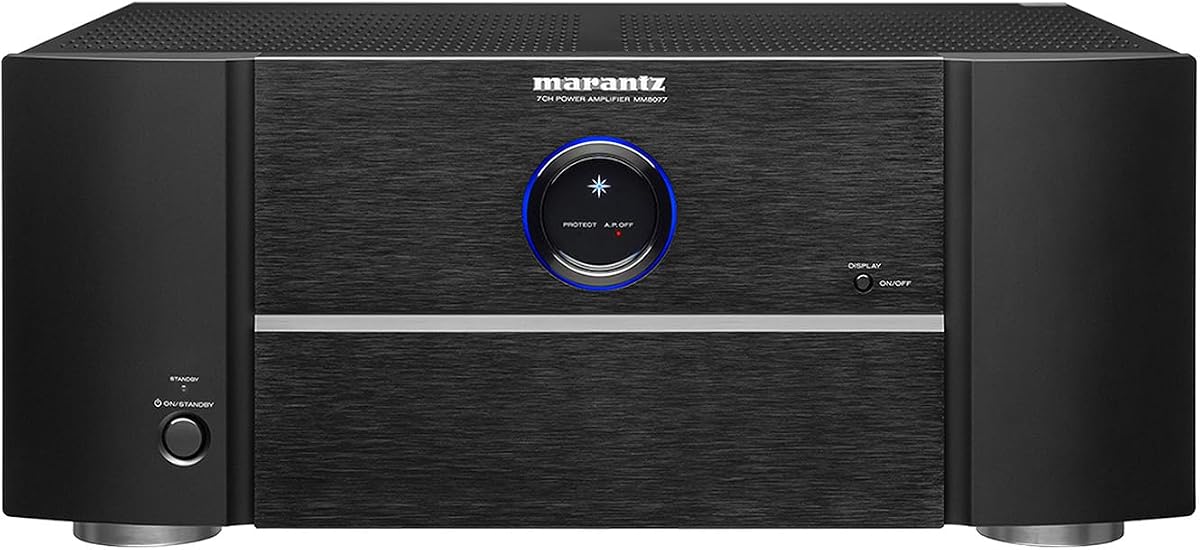
The Marantz MM8077 brings a different philosophy to the seven-channel category, emphasizing musical refinement, robust power supply design, and identical amplification across all outputs. Its customer rating of 4.1 is lower than the other rated products, so buyers should weigh both its engineering credentials and the mixed volume of customer feedback before deciding.
We may earn a commission when you buy through this link, at no additional cost to you.
Each channel is rated at 150 watts into eight ohms and 180 watts into six ohms. The same output-stage topology is used throughout, promoting consistent tonal and spatial performance across a home-theater speaker array. Discrete current-feedback topology is designed for high slew rate and wide bandwidth, helping the amplifier reproduce fast transients and high-resolution audio details.
A high-current toroidal transformer provides the energy reserve needed for dynamic peaks and demanding low-impedance loads. Reference-grade supply capacitors and high-speed, high-current discrete transistors support consistent output, while the copper-plated chassis and gold-plated speaker terminals reflect the premium construction. The MM8077 also offers auto-standby and remote power control for straightforward home-system integration.
Every channel accepts both balanced XLR and unbalanced RCA connections, which allows the amplifier to work with a broad range of processors and preamps. Its size and power requirements make it less relevant to a compact car installation. For a dedicated listening room or home theater, however, it is the most overtly audiophile-oriented choice in this list.
Identical output-stage topology across all seven channels promotes a uniform presentation. This is valuable in a theater, where the center and surround speakers should blend with the front pair rather than sound distinctly different.
The toroidal transformer and discrete current-feedback design focus on dynamic headroom. Such capacity helps when the system encounters sudden musical peaks or speakers with demanding impedance behavior.
We may earn a commission when you buy through this link, at no additional cost to you.
The AudioControl D-6.1200 is the most feature-rich DSP car amplifier in the group. Its 4.6 rating reflects a product aimed at serious installers who want to integrate factory audio, aftermarket speakers, and a subwoofer through one configurable signal-routing system. Although it has six channels rather than seven, its flexible operating modes make it relevant to complex car installations.
We may earn a commission when you buy through this link, at no additional cost to you.
The amplifier can operate as six, five, four, or three channels, allowing installers to allocate outputs according to the speakers in the vehicle. It accepts eight speaker-level inputs and six balanced RCA analog line-level inputs, with two assignable preamp outputs. This is especially useful when combining factory and aftermarket sources or when a conventional head unit does not provide enough independent outputs.
The DM Smart App gives users control over routing, crossovers, filters, and equalization. A 30-band graphic EQ and a 10-band parametric EQ for each output channel provide detailed tonal adjustment, while selectable high-pass, low-pass, and band-pass filters help direct the correct frequencies to each speaker. The signal-to-noise ratio is listed at over 90 dB, which is strong for a car amplifier.
Built-in bass roll-off correction compensates for low-frequency loss caused by factory head-unit processing. The amplifier also provides clipping detection, diagnostic status reporting, and signal-sensing startup and shutdown behavior. These features make it a powerful installation tool, although software complexity may deter buyers who only want basic gain and crossover controls.
Eight speaker-level inputs and real-time array tools make it possible to identify and sum factory signals accurately. This is valuable when a vehicle's factory electronics make conventional RCA integration difficult.
Configurable routing, multi-type filters, graphic EQ, and parametric EQ provide more adjustment than a conventional crossover-only amplifier. The app-based interface also makes tuning changes easier to repeat and document.
We may earn a commission when you buy through this link, at no additional cost to you.
The Pioneer GM-A6704 is a simpler alternative for buyers who do not need seven discrete outputs. Its four-channel Class AB design can power front and rear speakers, and the amplifiers can also be bridged when a higher output is needed for a subwoofer or pair of speakers. Its 4.4 rating indicates broad user satisfaction.
We may earn a commission when you buy through this link, at no additional cost to you.
At 60 watts RMS per channel into four ohms, the unit provides modest but usable power for common car speakers. Bridged operation increases the stated output to 190 watts RMS across two channels. Although the maximum output is advertised at 1,000 watts, that headline figure should not be confused with continuous output into an eight- or four-ohm load.
Variable high-pass and low-pass filters make it possible to set frequency ranges for different speaker types. That flexibility helps when the same amplifier drives both full-range speakers and dedicated tweeters or a subwoofer. A Class AB design balances efficiency with traditional sound characteristics and is intended to avoid the excessive heat sometimes associated with less efficient amplifier classes.
The principal limitation is channel count. There is no dedicated subwoofer channel, so a three-way front stage plus subwoofer would require careful channel allocation or another amplifier. For a straightforward four-speaker upgrade, the GM-A6704 remains approachable, proven, and easy to tune.
The four-channel layout matches a common two-door or four-door upgrade. It provides clear channel allocation without requiring a complex matrix or software interface.
Bridged operation offers more power when the channel map allows it. This makes the amplifier useful for a dedicated subwoofer or a pair of higher-output speakers as well as conventional multichannel use.
We may earn a commission when you buy through this link, at no additional cost to you.
The AudioControl EPICFIVE combines five channels with a compact digital Class D design, making it a practical option for modern car installations where trunk or under-seat space is limited. Its 4.4 customer rating suggests that users appreciate the balance of power, remote bass control, and flexible crossover settings.
We may earn a commission when you buy through this link, at no additional cost to you.
The stated maximum output is 1,100 watts, with a signal-to-noise ratio above 91 dB. Line-level inputs support use with aftermarket head units, while the five-channel architecture can handle four full-range speakers and one subwoofer. Its dimensions of 6.1 inches wide by 13.35 inches long and 2.01 inches tall reinforce its suitability for space-conscious builds.
The included ACR-E remote controller can be mounted with the supplied dash bracket or flush-fitted into the dashboard or console panel. That allows the driver to adjust subwoofer level without opening a trunk or reaching into a footwell. A variable zero-to-12 dB bass equalizer adds tonal control, while twelve-dB-per-octave Linkwitz-Riley crossovers guide each frequency range to the appropriate speaker.
Several practical safeguards are included: audio sensing for automatic startup and shutdown, protection against low or high voltage, short-circuit and thermal faults, and an ultra-efficient idle mode intended to reduce battery drain. Direct-wire terminals are supplied for dependable power and speaker connections. The amplifier falls short of seven true outputs, but it is a well-rounded option for standard four-speaker-plus-subwoofer systems.
The low-profile digital chassis is designed to fit where a larger conventional amplifier may be impractical. Compact dimensions are especially useful in vehicles with limited trunk space or under-seat mounting options.
A dashboard-mounted remote makes subwoofer level adjustments easy, while automatic signal detection removes the need for a separate manual turn-on step. Voltage, short-circuit, and thermal protections add confidence during daily use.
We may earn a commission when you buy through this link, at no additional cost to you.
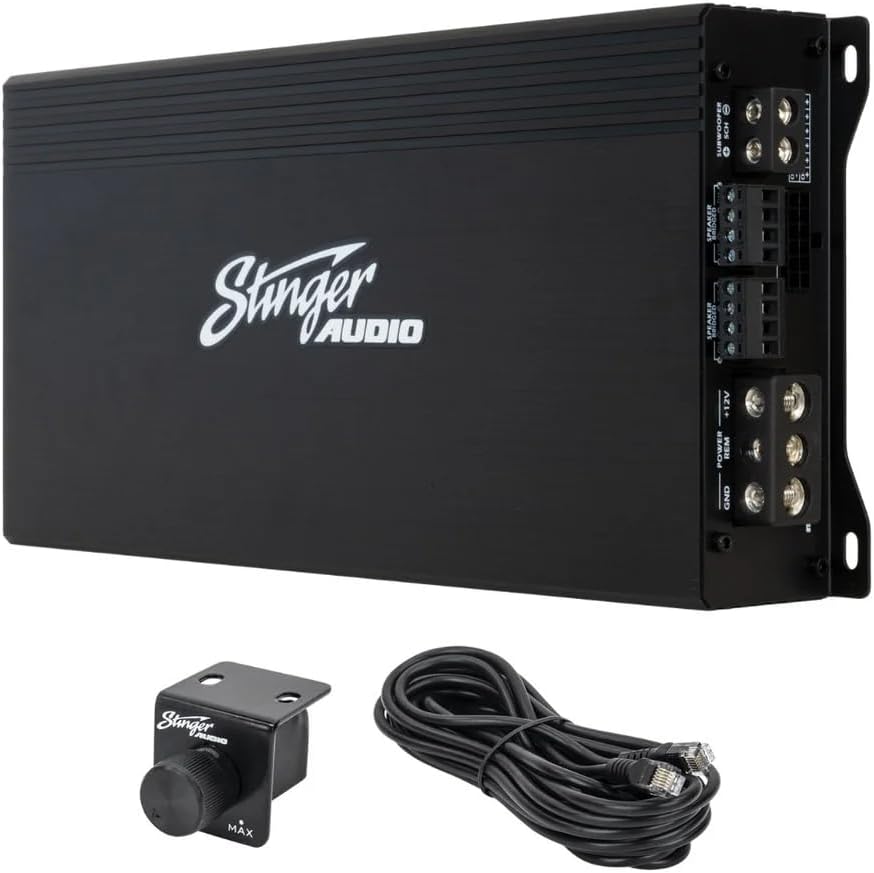
The Stinger MT-1000.5 is a compact five-channel Class D amplifier built around the needs of car installations. Its 4.3 rating places it among the more modestly rated products here, but the feature set is focused: four full-range channels, a dedicated bass channel, high-level input support, and a remote controller.
We may earn a commission when you buy through this link, at no additional cost to you.
The amplifier delivers up to 75 watts by four plus 300 watts by one at four ohms, up to 150 watts by four plus 500 watts by one at two ohms, or 700 watts for one channel at one ohm. Bridged output can reach 300 watts by two at four ohms. As with other amplifiers, these options are configuration-specific and should not be read as one continuous output rating across every channel and impedance.
Its input flexibility is useful in real vehicles. The RCA connectors can be cut to accept high-level speaker-wire input, or the preamp signal cables from the head unit can be connected for low-level operation. A zero-to-12 dB bass control provides a quick tonal adjustment, and the included remote controller can be mounted in the dash, console, or another accessible location.
Advanced pulse-width-modulation circuitry and a special high-frequency capacitor support efficient switching and MOSFET protection. Direct-insert power and speaker terminals reduce connection resistance. Although it lacks a seven-channel layout and sophisticated DSP, the MT-1000.5 delivers a useful combination of compactness, flexible inputs, and dedicated bass output for value-conscious car builders.
The ability to use either preamp-level connections or high-level speaker-wire input broadens the amplifier's compatibility with factory and aftermarket head units. This can simplify an upgrade without requiring extensive signal-conversion hardware.
The fifth channel is built for a subwoofer and can provide substantial output into a one-ohm load. A separate in-cabin remote gives the driver quick level control without changing the amplifier's main gain settings.
We may earn a commission when you buy through this link, at no additional cost to you.
The best amplifier depends on your speaker count, source connections, available space, tuning goals, and electrical environment. These factors help determine whether a true seven-channel unit, a configurable six-channel DSP, or a simpler five- or four-channel amplifier is the more practical choice.
Start by mapping every speaker that needs power and how it will be driven. A home-theater system commonly uses five full-range channels plus two bass channels, while a sophisticated car installation may require four door speakers, two or more tweeter channels, and a subwoofer. A true seven-channel amplifier offers the cleanest match, but a five-channel model can cover four speakers and a subwoofer in a smaller installation. Configurable amplifiers add flexibility when channel assignments need to change.
Choose the channel layout that matches your speakers rather than buying on channel count alone. More outputs do not help if they cannot be filtered or assigned appropriately.
Pay more attention to continuous RMS power at the impedance of your actual speakers than to a maximum headline figure. An amplifier rated at a large wattage under ideal conditions may deliver less power continuously, and ratings can change when several channels operate at once. Check the documentation for all-channel and per-channel figures, especially if a powerful subwoofer shares the enclosure with multiple full-range speakers.
Match the amplifier's stable impedance range to every speaker you intend to connect. A subwoofer with a one-ohm rating requires a mono section that is specifically designed to handle that load.
Correct frequency allocation is essential in any multichannel system. Full-range drivers, midrange speakers, tweeters, and subwoofers need different filter ranges. Look for adjustable high-pass, low-pass, band-pass, and subsonic filters, then confirm their available slopes. Twelve-dB-per-octave Linkwitz-Riley filtering and eighteen-dB-per-octave Butterworth options can offer useful control, while a DSP provides more extensive EQ and routing.
More filter options are useful only when you understand them. Choose controls broad enough for the system, but also simple enough that you can hear and verify each adjustment.
Balanced XLR inputs can reduce noise in professional or long-cable home installations. RCA inputs maintain compatibility with most consumer preamps, receivers, and car head units. Factory car systems may require high-level speaker inputs, a signal converter, or an amplifier with an input summing array. Some products also provide preamp outputs, allowing the system to grow without replacing the entire signal chain.
Confirm the type and quantity of inputs before purchasing. A balanced input is valuable in the right system but does not compensate for an amplifier with too few usable channels.
A car amplifier operates on the vehicle's low-voltage electrical system, so current draw, grounding, fusing, and power-wire gauge deserve careful attention. High-output subwoofer channels can place substantial demand on the battery and alternator, particularly when the music is loud for extended periods. An efficient Class D design can reduce heat and current consumption, while low-voltage cutoff, short-circuit protection, and thermal monitoring help protect the installation.
Use properly rated power cables, secure connections, and correctly specified fuses. Installation hardware must be suitable for the current involved, not merely the amplifier's wattage label.
A home-theater amplifier should integrate cleanly with the surrounding system. Twelve-volt trigger support enables coordinated startup, auto-standby reduces unnecessary operation, and channel status indicators can simplify diagnosis. Balanced inputs are advantageous when the rack sits far from the processor or when other equipment shares the room. A chassis with adequate ventilation is also essential for sustained high-power operation.
Plan the rack space, cooling, and control wiring before ordering. A technically powerful amplifier remains inconvenient if it cannot be positioned safely or switched with the rest of the theater.
Compact Class D amplifiers often fit more easily in a vehicle, while high-current home amplifiers may need a dedicated shelf or rack position. Height, depth, mounting clearance, cable bend space, and ventilation requirements all affect installation. Larger enclosures are not automatically better, but a physically undersized amplifier may require aggressive gain reduction or run hotter than intended.
Measure the available area before buying and leave room for connections. Check whether the amplifier is designed for horizontal mounting and whether its ventilation openings can remain unobstructed.
Useful safeguards include short-circuit detection, thermal protection, DC-offset protection, low-voltage cutoff, and high-voltage cutoff. Onboard monitoring can reveal temperature, voltage, and protection status, making installation problems easier to isolate. In-car remotes for subwoofer level, auto-standby, and signal-sensing startup add convenience, although they should support rather than replace correct gain and crossover setup.
Prioritize reliable protection and clear diagnostics over decorative extras. These features matter most when the amplifier is installed where you cannot easily see its indicators.
Begin by documenting the amplifier's channel map before connecting speakers. Label each output, input, control, and power lead, then assign speakers according to their impedance and crossover requirements. In a car, use appropriately rated power and ground cables, install the specified fuse close to the battery, and make sure the amplifier is securely mounted with its ventilation paths unobstructed. In a home theater, maintain airflow around the chassis and confirm that the rack can support the unit.
Set gain with the source and speakers properly configured. Use a familiar recording, raise the head-unit or preamp output gradually, and adjust gain so the amplifier reaches clean, controlled output without clipping. Next, set crossover points for each driver type, confirm phase relationships, and make small EQ changes while listening to several kinds of music. Save the final settings so the tuning can be reproduced if the amplifier or speakers are replaced.
Care for the unit by monitoring protection indicators, keeping connections secure, and avoiding repeated full-throttle level changes that create heat or excessive current draw. Periodic inspection can reveal loose terminals, damaged insulation, or corrosion. Use the included remote controls for everyday bass-level changes instead of altering internal gain settings, and follow the manufacturer's guidance for cleaning the chassis without allowing moisture to enter the enclosure.
A 7-channel amplifier can be better when the goal is a tidy installation with fewer power devices and coordinated controls. It may simplify wiring and reduce installation space, particularly in a car with four main speakers, additional tweeter channels, and a subwoofer. Separate amplifiers can still be preferable when each component requires different features, independent thermal management, or specialized signal processing.
Yes, if your speakers can be assigned effectively across five outputs. Many car systems use four full-range channels and one dedicated subwoofer channel, so a five-channel amplifier can meet the requirements without seven physical outputs. It cannot independently power five full-range channels plus two subwoofer channels unless the system uses creative channel sharing or additional amplification.
The speakers should fall within the amplifier's stated stable impedance range at the intended configuration. Always check the manual because an amplifier that supports one-ohm subwoofer operation may behave differently when several channels are connected simultaneously. Bridged outputs also require proper two-speaker loads and careful attention to polarity.
No. Maximum wattage is usually the highest short-term figure under particular conditions, while RMS power is more useful for sustained output. Continuous per-channel ratings, total all-channel output, distortion, signal-to-noise ratio, efficiency, and protection design tell you more about real performance than a single maximum number.
No. Both classes can produce low noise when designed and operated properly. Class D amplifiers are often more efficient and compact, while Class AB designs may provide substantial continuous power and are common in dedicated home-theater amplifiers. Compare measured noise, distortion, thermal behavior, and output stability rather than assigning a universal preference.
They are usually unnecessary in a typical passenger car because cable runs are short and ambient electrical noise is limited. Balanced inputs can still be useful in professional vehicles, long installations, or systems with complex grounds. For most home theaters, balanced inputs may help when the equipment rack is distant from the processor or shares power with other high-current components.
It changes the level sent to the subwoofer channel without altering the amplifier's main gain setting. This is useful for different music, passengers, or road conditions, especially in a car. The main gain should still be set correctly and left alone so the remote operates within a safe adjustment range.
The correct amount depends on the subwoofer's sensitivity, enclosure volume, excursion, and the desired output level. A low-power, high-sensitivity subwoofer can sound excellent with relatively little amplifier power, while a lower-sensitivity model may need much more. The amplifier's continuous rating at the subwoofer's impedance should be matched carefully to its thermal and mechanical capabilities.
The Kicker LX1300.7 stands out for the most complete package in the guide, combining five full-range channels, a powerful mono bass channel, real-time monitoring, remote bass control, and high-voltage signal support. The OSD Audio Nero HTA7200 is the strongest dedicated home-theater choice, while the KENWOOD KAC-835 delivers a focused five-channel system with useful filtering and a 5.0 customer rating.
Prioritize the features your installation actually requires. A complex DSP car system benefits from flexible routing and factory-signal integration, a home theater needs balanced connectivity and reliable triggering, and a straightforward vehicle upgrade may be best served by a compact five-channel amplifier with a subwoofer channel. Verify continuous power at the intended impedance, channel allocation, protection, ventilation, and connector compatibility before finalizing a purchase.
Product specifications, customer feedback, availability, and prices can change over time. Review the current listing and manufacturer instructions, especially the channel map and load requirements, before ordering. With the correct match between amplifier and speakers, a multichannel system can provide cleaner power, easier control, and a more organized path from source to listening position.