
ISDT BG-8S Battery Meter
4.7Editor score
BattGO-compatible battery information
Automatic cell balancing
XT60i and balance lead support
USB power-bank output
Discover the best Li Ion Battery Tester options for 18650 cells, RC packs, and household batteries, compared for accuracy, features, compatibility, and ease of
A Li Ion Battery Tester helps determine whether a lithium battery is healthy, weak, or unsuitable for its intended device. The right model can measure voltage, capacity, internal resistance, cell balance, and even charging performance. Because battery formats and diagnostic needs vary widely, the most useful tester depends on whether you work with 18650 cells, removable RC packs, or mixed household batteries.
We compared the ten products in this guide by examining their supported battery chemistries, measurement functions, display options, connection methods, portability, and intended uses. The list covers dedicated multi-channel 18650 analyzers, feature-rich RC battery meters, compact voltage checkers, and a universal load tester. Each pick reflects a distinct combination of capabilities rather than simply ranking one measurement style above every other.
Reading the entries will help you identify which tester fits a particular battery and workflow. Some focus on quick field checks, while others perform automatic charge-and-discharge cycles or display detailed pack information. Ratings and technical details reflect the supplied product information, and current prices, availability, connector bundles, and firmware support can change, so confirm the latest listing details before purchasing.
4.7Editor score


4.7Editor score
This side-by-side comparison highlights each tester's best-supported use case, from single-cell 18650 analysis and multi-cell RC pack inspection to broad household battery compatibility.




This four-channel module is built for people who need more than a simple voltage reading from 18650 lithium-ion cells. It earns a 4.3 rating and stands out for combining capacity, internal resistance, voltage, current, power, and battery-level information on a 1.77-inch screen. Its Type-C connection also makes it relevant to modern workbenches where an older barrel connector would be inconvenient.
We may earn a commission when you buy through this link, at no additional cost to you.
The most attractive feature is the ability to work with four cells at once. Each channel can support a broad stated capacity range of up to 99999mAh, while the integrated charge-and-discharge process reduces the need to move cells repeatedly between separate equipment. Real-time voltage, current, and power readings make it easier to observe behavior throughout a cycle rather than relying on one static measurement.
There are trade-offs. The stated measurement error is about ten percent, so readings should be treated as useful diagnostics rather than laboratory-grade certification. The module is also more specialized than a simple handheld checker and requires compatible 18650 cells and suitable charge or discharge equipment. The manual is reportedly available through a particular buyer-service process rather than being immediately accessible in the standard listing.
This is a strong choice for battery builders, repair technicians, hobbyists, and anyone sorting a collection of 18650 cells. Choose it when detailed cycle data and multi-channel throughput matter more than a pocket-sized voltage check. For users who only need to know whether a household battery has a reasonable charge, a universal tester will be more convenient.
Four-channel operation can substantially reduce the time needed to compare or sort multiple 18650 cells. The tester is especially useful when establishing which cells perform similarly before combining them in a pack.
Capacity, internal resistance, current, power, voltage, and battery level appear together, allowing you to evaluate several health indicators during the same automatic testing workflow.
We may earn a commission when you buy through this link, at no additional cost to you.
The Dlyfull DB1 is a universal checker for anyone who wants to inspect the batteries scattered around a home rather than focus exclusively on RC equipment. It has a 4.5 rating and supports Ni-MH, alkaline, lithium, Li-ion, and 9-volt batteries across AA, AAA, C, SC, D, N, button-cell, and several lithium formats. The broad compatibility makes it especially practical for smoke detectors, remotes, flashlights, toys, and household electronics.
We may earn a commission when you buy through this link, at no additional cost to you.
Its magnetic slot is more useful than it initially sounds. The cell is placed in the tester and secured with a magnetic slider, reducing the chance that a cylindrical battery will slip while the user is trying to read the display. A large digital screen indicates whether voltage is good, weak, or poor, while one-touch controls handle battery-type selection, buzzer settings, and power.
The trade-off is that this is primarily a voltage and general-health checker rather than a true capacity or internal-resistance analyzer. It also does not need frequent power-supply batteries because its rechargeable design is rated for up to 15 hours of use after a full charge. A USB-C cable is included, although an adapter is not.
Buy this model if you want one simple device for many battery types and do not need laboratory-style cycle testing. It is a particularly good household companion for quickly finding weak cells before they cause an electronics failure. Serious pack builders should consider one of the dedicated RC meters or 18650 analyzers instead.
Support for common cylindrical batteries, button cells, lithium CR formats, Ni-MH, alkaline, and Li-ion chemistries reduces the need to keep several specialized testers on hand.
The magnetic retention slider keeps the cell steady, while the digital display and straightforward one-touch controls make the tool approachable for occasional users.
We may earn a commission when you buy through this link, at no additional cost to you.
The RC Cellmeter 8 provides a convenient way to inspect LiPo, Li-ion, NiMH, and NiCd batteries, and its 4.4 rating reflects a generally well-received balance of capability and ease of use. Its large LCD and one-click measurement button make it suitable for RC hobbyists who want useful pack information without navigating a dense menu of professional settings.
We may earn a commission when you buy through this link, at no additional cost to you.
Voltage and capacity measurement are the central features, giving users more insight than a bare terminal meter. The meter supports several common rechargeable battery families and is designed for quick diagnostics of electric devices and RC packs. A minimum operating voltage of 1.2 volts defines the lower limit for compatible connected batteries.
It does not offer the depth of the premium ISDT products, which add advanced balancing, protocol analysis, and power-output functions. Nor does the supplied description indicate the same range of connector choices or detailed per-cell diagnostics. Buyers who need only a clear, approachable pack check may find those omissions irrelevant.
This is a good middle-ground choice for hobbyists and everyday users who want more than a voltage reading. It suits users who can work primarily with standard supported battery packs and value a simple display and button. For balancing, BEC testing, or extensive connector compatibility, one of the more specialized models is the better fit.
A large display and one-click measurement process reduce the amount of setup required for routine pack inspection, making the meter approachable for new RC equipment owners.
Support for LiPo, Li-ion, NiMH, and NiCd packs covers several popular rechargeable formats used in drones, vehicles, radio equipment, and other hobby devices.
We may earn a commission when you buy through this link, at no additional cost to you.
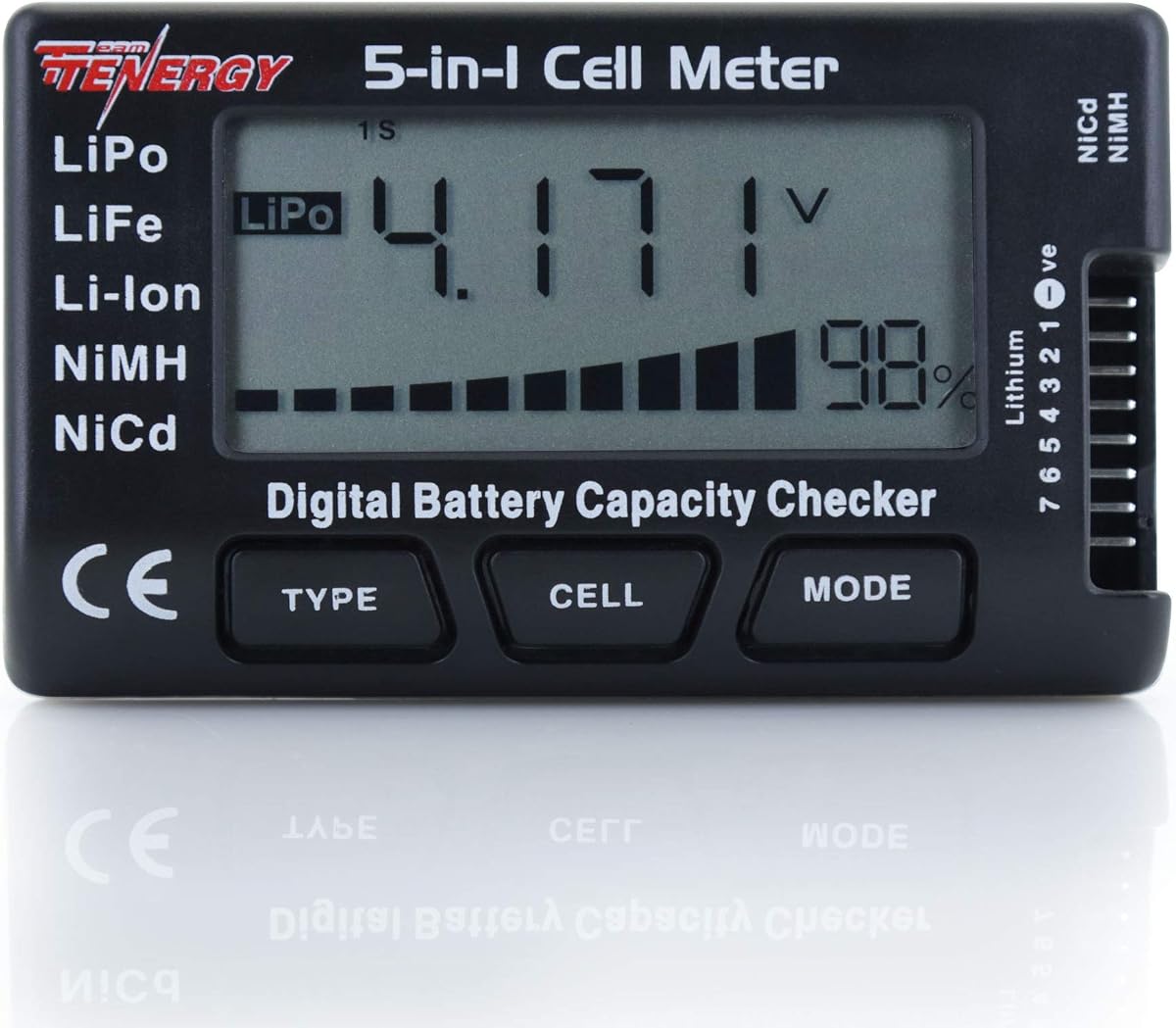
The Tenergy 5-in-1 is a capable pack meter for users who want to inspect lithium and nickel-based battery packs and take corrective balancing action. Its 4.6 rating reflects a useful feature set covering voltage estimation, controlled discharge, balancing, capacity evaluation, and internal resistance for individual lithium cells.
We may earn a commission when you buy through this link, at no additional cost to you.
Compatibility is a major strength. It handles LiPo, LiFePO4, and Li-ion packs with two to seven cells, plus four-to-seven-cell NiCd and NiMH transmitter and receiver packs. It works with lithium balance connectors and NiCd or NiMH packs using Hitech or Futaba connectors. The meter is powered by the connected battery, avoiding a separate power supply for routine operation.
The balancing function is more useful than simple voltage comparison because the unit can discharge lithium packs at 180mA down to an adjustable threshold. This can reveal imbalances and help prepare packs for charging. Internal-resistance readings for each lithium cell add another layer of health information, although the tool is intended for compatible packs rather than loose single cells.
Choose the Tenergy if you maintain RC equipment and understand its connector requirements. It offers a strong combination of balancing, resistance, and pack evaluation without requiring extra accessories. It is less suitable for a first-time tester user seeking a universal household battery format or for anyone who needs an eight-channel 18650 analysis system.
The adjustable 180mA discharge and balancing function can help identify uneven cells and improve pack consistency before normal use.
Individual lithium-cell internal resistance readings give users a more nuanced view of pack health than a single overall voltage number can provide.
We may earn a commission when you buy through this link, at no additional cost to you.
The FLY RC Cellmeter 7 is a compact, no-frills pack meter centered on the information most RC users need for a quick condition check. It carries a 4.6 rating and supports four-to-seven-cell NiCd or NiMH packs alongside two-to-seven-cell lithium batteries, including the LiPo, LiFe, and Li-ion formats named in the product information.
We may earn a commission when you buy through this link, at no additional cost to you.
Its display is more informative than a single total-voltage number. It can show cell voltages, total voltage, the lowest cell, the highest cell, the voltage gap between them, and an estimated remaining capacity percentage. That combination makes it easy to spot a weak cell or an unbalanced pack, which is often more important than a precise aggregate capacity figure.
The main limitation is that the supplied feature list does not mention cell balancing, internal resistance, charging, or power-bank output. Users seeking a full maintenance system will need a more advanced model. The compact and lightweight design, however, makes this meter easy to carry to the field for drones, cars, and aircraft.
This is a compelling choice for hobbyists who want fast, readable pack diagnostics without carrying a large device. It is especially helpful for checking whether the weakest cell is pulling down an otherwise healthy-looking pack. Choose it for portability and clear cell comparison, not for advanced balancing or deeper battery analysis.
Minimum, maximum, and difference readings quickly reveal whether one cell is significantly weaker than the others in a connected pack.
The lightweight format and straightforward display are well suited to quick checks at the workbench, in a garage, or at an RC flying field.
We may earn a commission when you buy through this link, at no additional cost to you.
The ISDT BG-8S Lipo Battery Checker combines intelligent battery monitoring with balancing and power-output functions. It has a 4.4 rating and is designed for LiPo, Li-ion, LiFe, LiHv, NiMH, NiCd, and BEC output measurements. Connecting through XT60i and using BattGO provides access to cell voltages, cycle counts, and working parameters for a more complete overview of pack history.
We may earn a commission when you buy through this link, at no additional cost to you.
Its automatic balancing algorithm helps bring cells closer to a common level after testing, and the unit enters low-power mode when the balancing process is complete. Connection options include XT60 and XT60i, XH2.54 one-through-eight-cell balance leads, XH2.54 three-pin connectors, and JST, making it versatile for a broad collection of hobby batteries.
It can also operate as a power bank for compatible mobile devices, with stated support for Qualcomm Quick Charge 2.0 and 3.0, BC1.2, Apple devices, and output up to 12V at 2A. This creates useful versatility, although the dense collection of features may feel more complex than a basic voltage checker.
This model is well suited to RC pilots and technicians who maintain mixed battery systems. It is less attractive for someone who only needs to test an AA cell or a loose 18650 without connectors. If deeper pack telemetry and automatic balancing are priorities, the BG-8S offers considerably more than a simple cell-voltage display.
BattGO and XT60i connectivity can expose cell voltage, battery cycles, and operating parameters, giving owners more context than an isolated voltage reading.
The integrated power-bank function turns the checker into a portable output source for selected phones and other compatible electronics.
We may earn a commission when you buy through this link, at no additional cost to you.
The ISDT BG-8S Battery Meter is the most comprehensively equipped premium option in this guide, earning a 4.7 rating. It combines detailed battery intelligence, automatic balancing, multiple charging connections, a power-bank function, BEC output testing, and protocol analysis in a single digital device for LiPo, Li-ion, LiFe, LiHv, NiMH, and NiCd batteries.
We may earn a commission when you buy through this link, at no additional cost to you.
Through BattGO and an XT60i connection, users can view cell voltage, battery cycles, and working parameters, then adjust settings to their preferences. Automatic matching works to balance individual cells and can help maintain consistency across a pack. The unit supports XT60, XT60i, XH2.54 one-through-eight-cell balance leads, XH2.54 three-pin, and JST connections.
A standard three-pin connection allows the meter to measure BEC output voltage, while protocol analysis covers PWM, PPM, and S.Bus, with more protocols potentially available through future firmware updates. Its portable power-bank function supports Qualcomm Quick Charge 2.0 and 3.0, BC1.2, Apple devices, and up to 12V at 2A. That breadth makes it much more than a simple meter.
The primary downside is complexity. Casual users who only need an occasional voltage check may find the menu and connection options excessive, while advanced features depend on the right cable or battery system. For RC enthusiasts, repair technicians, and collectors who want one premium tool for multiple roles, this is the strongest all-in-one recommendation.
Cycle counts, working parameters, cell voltages, and configurable settings provide a richer picture of battery condition than ordinary voltage-only meters.
Automatic balancing, BEC measurement, protocol analysis, and USB power output allow the meter to support testing, pack care, and limited field power needs.
We may earn a commission when you buy through this link, at no additional cost to you.
The Advanced 8 Channel Battery Tester is built for users who need to analyze 18650 lithium batteries in batches. Eight independent channels can operate simultaneously or separately, allowing a technician to compare multiple cells without repeated physical setup. A 2.4-inch color screen shows real-time charging and discharging information, including voltage, current, and internal resistance.
We may earn a commission when you buy through this link, at no additional cost to you.
Automatic cycling supports seamless charge-and-discharge workflows, while adjustable voltage settings and reverse-connection protection add safeguards around cell handling. The compact enclosure and active heat-dissipation system are intended for laboratories, workshops, and home workbenches where repeated testing can generate heat.
This tester is highly specialized. It focuses on 18650 cells rather than providing the broad household format support seen in universal checkers, and no customer rating is currently supplied for it. The absence of a rating does not prove poor performance, but it does mean there is less visible customer feedback to help establish long-term reliability.
Choose it for battery recyclers, serious hobbyists, engineering work, or any workflow involving several 18650 cells at once. Its eight-channel design and automatic modes can save considerable time compared with testing one cell at a time. Users seeking a pocket checker for assorted AA batteries should look elsewhere.
Eight independent channels make the device especially practical for sorting, comparing, and cycling a collection of 18650 batteries in one session.
The color screen presents real-time voltage, current, and internal resistance information, making changes during a charge or discharge easier to follow.
We may earn a commission when you buy through this link, at no additional cost to you.
The QWORK RC Battery Capacity Checker delivers a focused set of pack diagnostics at a modest, budget-friendly level. It has a 4.7 rating and supports two-to-seven-cell LiPo, Li-ion, and LiFe packs along with four-to-seven-cell NiMH and NiCd packs. That makes it well suited to drones, RC cars, aircraft, and other hobby equipment.
We may earn a commission when you buy through this link, at no additional cost to you.
The digital display shows total voltage, each cell's voltage, the maximum cell, the minimum cell, and the difference between them. Those readings allow users to recognize an unbalanced pack quickly, which is often the most useful information when deciding whether a battery is ready for use. The compact, lightweight body also supports convenient field inspection.
Its limitations are clearly defined. A 2–7S port and balance connector are required, so it cannot test a single loose cell. It also does not charge batteries or provide the deeper capacity, balancing, resistance, or telemetry functions found in more advanced meters.
This is the best value pick for RC hobbyists who need dependable voltage and imbalance information without paying for a feature-heavy analyzer. It is a natural choice for people who already understand balance connectors. Beginners working with loose 18650 cells or household battery formats should select a more versatile model.
Maximum, minimum, and voltage-difference readings give a quick way to identify a cell that is substantially weaker than the rest of a pack.
Support for common lithium and nickel-based pack configurations makes the checker relevant to drones, radio-control cars, aircraft, and other hobby systems.
We may earn a commission when you buy through this link, at no additional cost to you.
The ZTS Mini-MBT focuses on a more meaningful question than open-circuit voltage alone: can a battery still perform under load? It has a 4.5 rating and uses patented Pulse Load Technology to assess charge and battery life while drawing current. That approach can reveal weak or failing cells that may otherwise appear normal on a basic voltage display.
We may earn a commission when you buy through this link, at no additional cost to you.
Operation is exceptionally simple. There are no switches or settings, and the fully automatic test takes about two seconds. The tester identifies weak or failing 1.5-volt AA, AAA, C, D, and N batteries, 1.2-volt NiMH and NiCd cells, 3.6-volt Li-ion, 3-volt photo lithium, and 9-volt alkaline batteries.
Its limits center on pack-level and advanced analysis. It is not designed for multi-cell RC balance connectors, automatic cell balancing, detailed cycle telemetry, or the sort of channel-based testing offered by an eight-channel 18650 analyzer. The main value comes from its fast load test of individual cells and its simple operation.
This tester is ideal for households managing many loose batteries, recyclers checking remaining capacity, and users who want a quick answer before discarding a cell. Its small size, stored lead, and probe also make it convenient for travel. Choose it for reliable quick checks rather than advanced battery engineering.
Pulse Load Technology evaluates how a cell behaves while current is drawn, providing a stronger indication of condition than a resting voltage alone.
The automatic two-second sequence and absence of manual controls make the Mini-MBT practical for occasional household and recycling checks.
We may earn a commission when you buy through this link, at no additional cost to you.
The right Li Ion Battery Tester depends on the battery format, chemistry, connector, and depth of diagnosis you need. Consider whether you want a quick voltage check, load testing, pack balancing, capacity analysis, or automatic cycling before making a selection.
Start with the physical format of the batteries you intend to test. A dedicated 18650 analyzer is optimized for removable cylindrical lithium cells, while an RC meter may require a balance connector and a specified cell count. Universal household testers can accommodate several sizes and chemistries, but they usually do not provide the same capacity or internal-resistance analysis. Button cells, 9-volt batteries, transmitter packs, and loose lithium-ion cells require very different contact arrangements and measurement approaches.
Choose a tester that directly supports the formats and cell counts in your collection rather than one that relies on an adapter or unusual connector.
A voltage-only checker is sufficient for a fast general-health indication, but it cannot fully establish remaining capacity or internal health. Load-based testers provide a better view of cell performance under demand. Capacity analyzers add charge-and-discharge cycles, while advanced RC meters can display cell resistance, imbalance, cycle information, and working parameters. The appropriate depth depends on whether you are organizing household batteries, maintaining a drone, or evaluating cells for a larger project.
Match the measurements to your decision: use simple voltage checks for quick sorting, but choose capacity or load testing when a weak cell could damage a device.
Balancing is particularly relevant to multi-cell lithium packs because individual cell voltages can diverge during use. A meter with an automatic balancing function can discharge and compare cells to help restore a more even state. The Tenergy model offers balancing at 180mA, while the ISDT BG-8S uses an automatic matching algorithm. A basic voltage checker may display imbalance but cannot actively correct it.
Prioritize balancing if you maintain RC packs or regularly combine cells, and choose a passive voltage comparison only when diagnosis is enough.
The connector determines whether a tester can connect directly to your batteries. RC meters commonly support balance connectors, XT60 or XT60i, XH2.54, JST, and occasionally transmitter-specific connections. The 8-channel 18650 unit instead uses individual cell channels, and universal household testers often rely on a spring-loaded or magnetic contact. Check the exact connector, polarity, and cell count before buying.
Prefer a tester with several supported interfaces if you own mixed equipment, but do not assume a stated chemistry guarantee means every connector is included.
A clear display matters most when you need to compare several readings quickly. Minimum and maximum cell voltages and the gap between them are easy to interpret on a large LCD. Advanced models add cell-level resistance, capacity, cycle count, and working data, which can be more useful but may require a steeper learning curve. Color screens and larger panels can make automatic cycles easier to monitor but may add bulk to a field kit.
Choose the simplest display that provides your required measurements, especially for travel or frequent one-handed checks.
Consider where the tester will be used. Compact RC meters are easy to carry to a flying field or race area, while multi-channel analyzers are better suited to a stable workbench. Some household testers recharge through USB-C and can operate for a long period between charges, whereas pack-powered meters draw energy from the connected battery. A tester that needs external power may be inconvenient for casual users.
Balance portability against capacity: highly specialized laboratories favor throughput, while field users should prioritize size, clarity, and simple power requirements.
A battery tester places current through a cell, so incorrect polarity, incompatible chemistry, or an unsuitable voltage can be hazardous. Reverse-connection protection, adjustable voltage thresholds, and clear compatibility markings are valuable safeguards. Automatic charge-and-discharge functions should also be used with compatible cells and appropriate equipment. Never treat a meter as protection against every battery failure; inspect cells for swelling, corrosion, damage, or leakage before testing.
Prioritize explicit protection features and follow the battery manufacturer's limits rather than relying on the tester to detect every unsafe condition.
Some advanced meters do more than diagnose batteries. The ISDT BG-8S can act as a power bank, measure BEC output, and analyze receiver protocols. These extras can reduce the number of tools needed in an RC setup, but they add complexity and may have little value for a user focused on loose lithium cells. A good purchase should offer useful functions rather than an intimidating feature count that you will never use.
Evaluate optional tools against your actual workflow, choosing deeper battery analysis or broader utility only when it serves a recurring need.
Before testing, identify the battery chemistry, nominal voltage, cell count, and connector type, then confirm that the tester explicitly supports those specifications. Inspect the cell or pack for leakage, corrosion, swelling, damaged insulation, or a damaged connector. Charged lithium cells can be hazardous when mishandled, so use the correct polarity and work on a stable, dry surface away from combustible materials.
Connect the tester according to its instructions. For a channel-based 18650 analyzer, place each cell in the correct channel and observe polarity markings. For an RC balance meter, attach the proper balance lead and make sure the cell count matches the selected mode. A universal or load tester should receive the cell directly or through its intended contacts. Start with the basic voltage display, confirm that the reading is plausible, and then proceed to capacity, resistance, balancing, or automatic cycling only when the battery and equipment are compatible.
After the test, disconnect the battery before changing leads or cells, and never leave an automatic charge-and-discharge process unattended unless the manual explicitly permits it. Store the tester in a dry environment, keep contacts clean, and replace damaged leads promptly. Update compatible smart-meter firmware when available, and follow the seller's guidance for calibration, service, and safe storage.
It depends on the tester and battery format. Basic voltage meters estimate condition but do not directly measure full remaining capacity, while load testers and capacity analyzers provide a stronger indication through current draw or controlled charge-discharge cycles. Accuracy also varies with battery age, chemistry, temperature, and the tester's stated tolerance. For critical applications, use a tester designed for capacity analysis and interpret the result alongside voltage and internal resistance.
No. Internal resistance describes how strongly a cell opposes current flow, while capacity describes how much charge it can deliver. A cell can have usable capacity and elevated resistance, or low resistance but poor remaining capacity. Reading both gives a more complete view of condition, which is why some multi-function meters display voltage, current, resistance, and capacity together.
Usually not. Most RC pack meters expect a multi-cell pack connected through a balance port and are not designed to analyze one loose cylindrical cell. The four-channel and eight-channel 18650 testers in this guide are better matched to that task. Always follow the stated cell-count and connector requirements, as forcing an incompatible connection can produce misleading results or create a safety risk.
A large difference between the highest and lowest cell suggests that a multi-cell pack is unbalanced. The weakest cell can limit the usable capacity of the entire pack, increase stress during discharge, and make charging less efficient. A meter that reports maximum, minimum, and difference readings can reveal the issue quickly. Active balancing models can also help correct imbalance, but damaged or severely mismatched cells may still need replacement.
No. Support for a lithium-ion chemistry does not automatically mean support for every physical format. Button cells, 9-volt batteries, and assorted cylindrical sizes may require a universal contact arrangement. The Dlyfull magnetic tester explicitly supports several of these formats, while most RC meters and 18650 analyzers are restricted to their intended cell or connector arrangements.
Only if your diagnostic workflow requires capacity analysis or active balancing. A voltage or load tester is faster and simpler for routine checks, while a capacity analyzer performs controlled cycles to estimate how much charge the cell can hold. If you routinely build or rebuild packs, automatic cycling can be valuable. For occasional household battery sorting, the additional complexity may not be necessary.
Only if the tester explicitly lists that chemistry and its appropriate voltage range. LiFePO4, Li-ion, LiPo, LiHv, NiMH, and NiCd cells have different voltage profiles and should not be treated as interchangeable. Universal household models may support several chemistries, while RC meters often include dedicated selectable modes. Checking the manual and the battery's rated voltage before connecting anything is essential.
Store it in a dry, temperature-stable location away from direct heat, moisture, and flammable materials. Keep the contacts and connector sockets clean, and coil or store loose leads so they cannot be pinched. A USB-rechargeable universal tester should be kept at a reasonable charge level, while pack-powered RC meters should be disconnected from batteries before storage. Consult the product instructions for any device-specific battery or calibration recommendations.
The Advanced 8 Channel Tester is the leading choice for detailed 18650 work, with eight independent channels, live measurements, and automatic cycling. The ISDT BG-8S Battery Meter takes the premium spot for RC users who want balancing, battery telemetry, BEC analysis, and power output in one device. The QWORK RC Capacity Checker is the strongest budget option for quick, portable voltage and imbalance checks.
Prioritize compatibility before features. A sophisticated meter is only useful if it supports your cell format, chemistry, connector, and cell count. Choose a simple universal or load tester for household batteries, a balance-capable RC meter for multi-cell packs, and a dedicated channel analyzer when testing loose 18650 cells or comparing a large batch.
Before ordering, confirm the latest connector inclusions, cell-count limits, measurement functions, warranty terms, and current availability. Ratings, technical details, and product offerings can change over time, and current prices also vary. Checking the current listing will help ensure that the selected tester still matches the specific batteries and workflow you have in mind.